The peace of faith in one place, the pain of history in another, the flavours of Punjab somewhere else, and national slogans echoing at the border — an account of experiencing Amritsar up close.
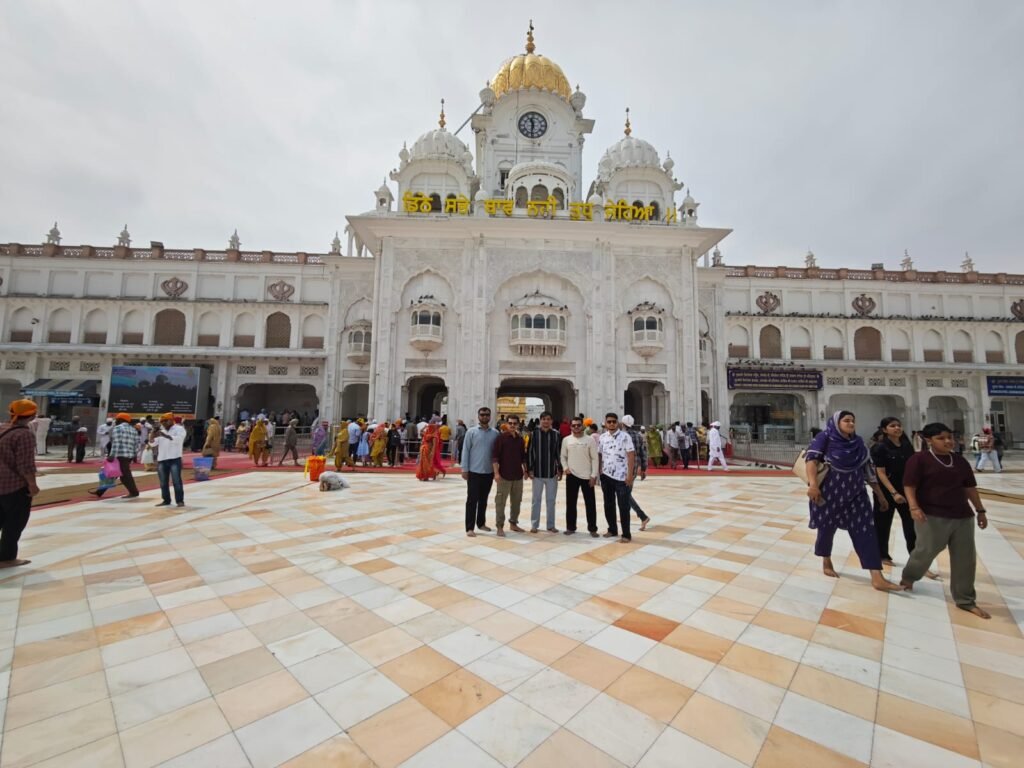
By the time we reached Amritsar, evening had already begun to set in. We looked for a budget-friendly hotel, which we found quite soon. The hotel and its rooms were quite good. We parked our car and took our respective bags. We had to stay here for the night.
After freshening up, all of us friends went out into the streets of Amritsar for dinner. At a restaurant, we found chicken dishes. We ate to our hearts’ content. Then we had tea from a man selling it at a cart in front of the bus stand.
The moment you step into Amritsar, it feels as though you have arrived not merely in a city, but in the midst of Punjab’s history, spirituality, and living culture. Founded by the fourth Sikh Guru, Guru Ram Das Ji, this city is considered the heartbeat of Punjab’s Majha region and an important cultural centre.
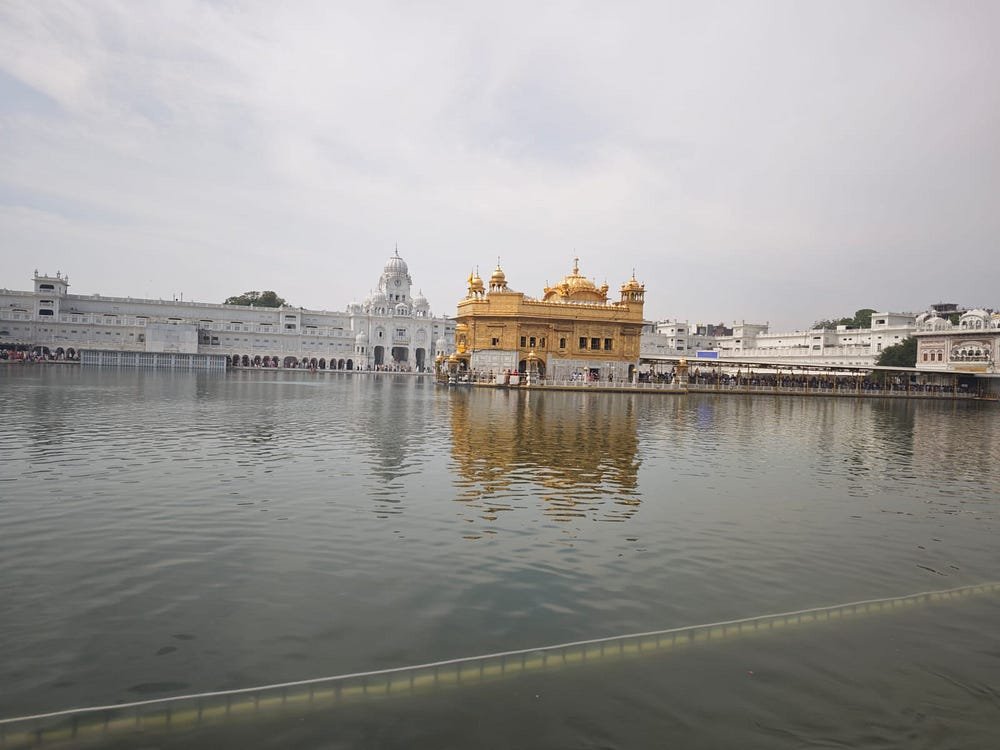
The city’s most prominent identity is Sri Harmandir Sahib, commonly known as the Golden Temple, which is counted among the holiest places in Sikhism. The city’s soul seems to come together in its peaceful sarovar, the resonating kirtan, and the langar that serves everyone without distinction of religion or caste.
In this very Amritsar, Jallianwala Bagh preserves within itself a painful chapter of India’s struggle for independence, while Durgiana Temple, various gurdwaras, mosques, and other religious and historical places further highlight the cultural diversity of the city. In this way, faith, history, and national memory in Amritsar do not feel separate from one another; rather, at every step, they seem intertwined.
But the true beauty of Amritsar is not limited only to its historical buildings and sacred places. The soul of this city lies in its people and their distinctive Punjabi way of life. Walking through the markets and old streets, the sweetness of the Punjabi language, the informal warmth of people’s conversations, and their hospitality create a unique sense of belonging.
The people here seem fond of food, lively, hardworking, and deeply connected to their culture and traditions. Whether it is clothing, food, the liveliness of the markets, or the way people speak, the colour of Punjab is clearly visible everywhere. Amritsar is an important centre of the Majha region, and the Punjabi spoken here has also held an important place in the development of Punjabi literature and the standard language.
Despite modernity, the city has preserved its traditional identity to a great extent. And perhaps this is Amritsar’s greatest characteristic: here, the past is not preserved only in books, but still seems to breathe in the language, food, places of worship, markets, and the everyday lives of the people.
In the morning, we got ready early because we had to visit the Golden Temple. On the way, we had breakfast at a roadside food stall. Soon, we reached there. There was a huge crowd of tourists.
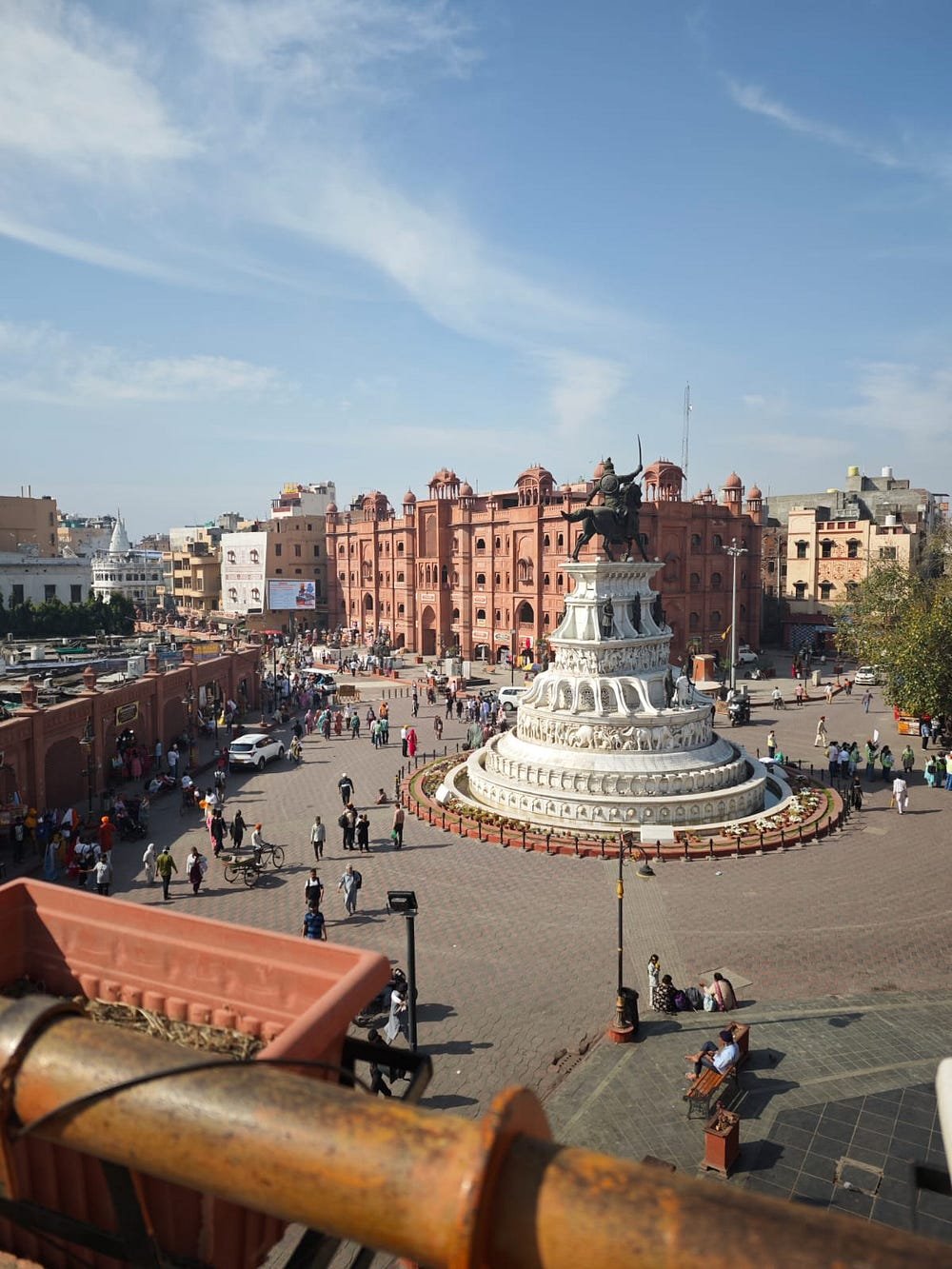
The entire area surrounding the Golden Temple is fully developed; it feels as though you have arrived in a European country. The roads are excellent and spacious, and there is a complete system for cleanliness. The entire area was a marketplace. Everything was available here. The prices were also quite reasonable compared with other places.
Inside, first we were given a sack in which to keep our shoes and slippers. We put the footwear of all our friends into it, packed it, and it was placed in a locker, while we were given a token with its number. This was an excellent arrangement. Because of this, neither were piles of footwear visible everywhere nor was there any possibility of them being stolen.
Then everyone had to cover their head. Handkerchiefs are kept here for that purpose. You can also cover your head with your own handkerchief, cap, or something similar. While walking in, you have to pass through a small pool meant to wash people’s feet. Then we entered the Golden Temple.
As soon as we entered the complex of the Golden Temple, also known as Sri Harmandir Sahib or Darbar Sahib, the reflection of the golden structure shimmered on the water in the middle of the sacred Amrit Sarovar, while the continuous sound of kirtan in the background gave the entire atmosphere a spiritual feeling.
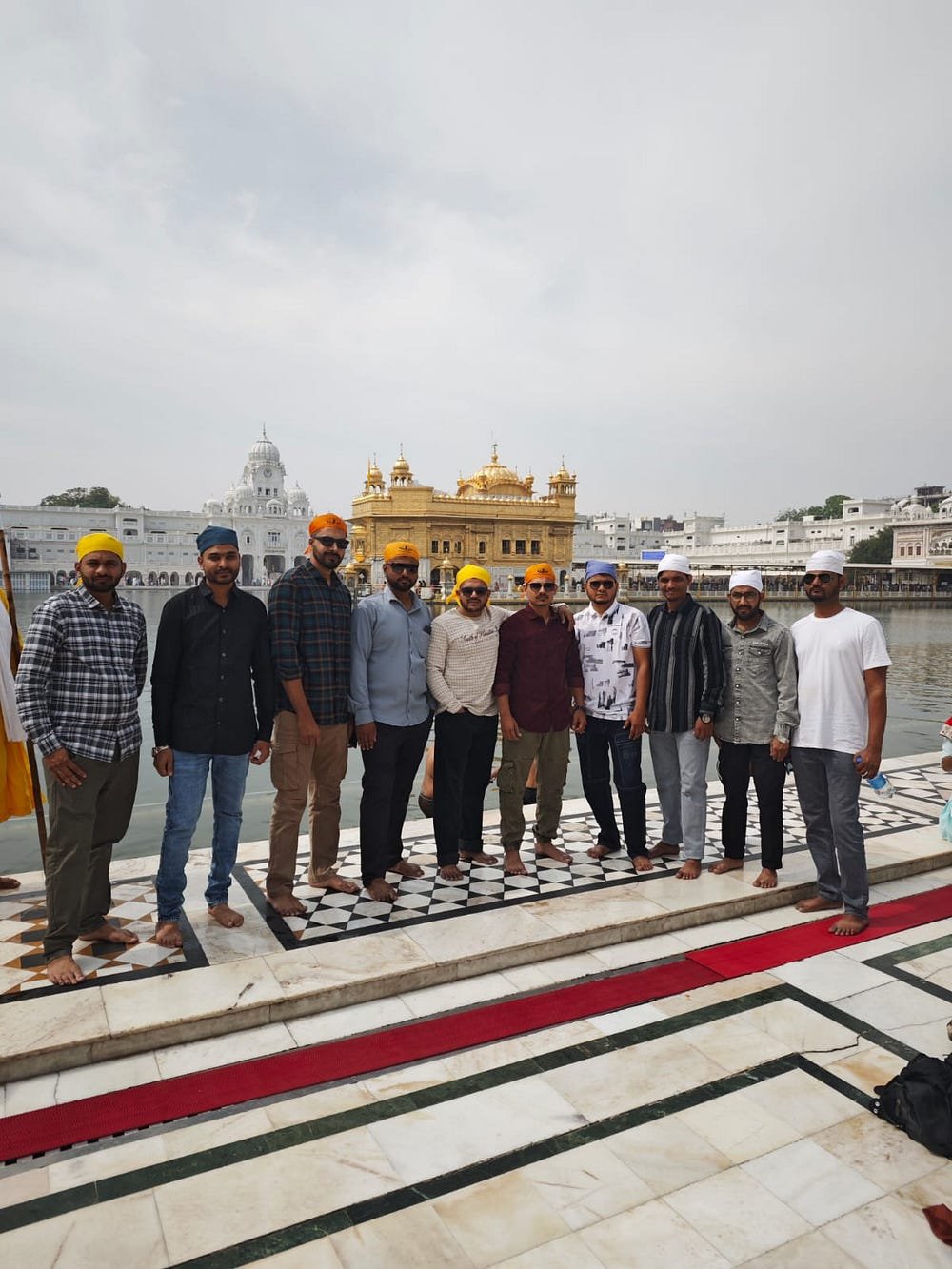
Standing there and learning about the history of this place was also a special experience for us.
The construction of the Amrit Sarovar began during the time of the fourth Sikh Guru, Guru Ram Das Ji, while the fifth Guru, Guru Arjan Dev Ji, had Harmandir Sahib constructed in the middle of the sarovar. In 1604, the Adi Granth was installed here, and Baba Buddha Ji was appointed its first granthi. Later, Maharaja Ranjit Singh had Harmandir Sahib adorned with gold, whose golden glow has now become its most prominent visual identity.
But more than its beauty, what impressed us here was the system of management, equality, and service at this place. The four entrances of Harmandir Sahib symbolize the idea that everyone is welcome here without discrimination based on caste, religion, gender, or social status.
Seeing the discipline of the people in the complex, the cleanliness, the sevadars performing seva, people from different religions and social groups sitting together in the same row, and the Guru ka Langar running twenty-four hours a day made us feel that equality here is not merely a religious teaching, but something visibly practised.
Someone was cooking food, someone was washing utensils, someone was serving food, and thousands of people were sitting together and eating.
The Akal Takht in front is also part of this vast complex. It was established by Guru Hargobind Sahib in 1609 and is a central seat of Sikh religious authority.
As I walk along the edge of the sarovar and once again look at the golden Harmandir Sahib, its reflection in the water, the people bowing in devotion, and the sevadars quietly serving, I realise that
the Golden Temple is not beautiful merely because of its golden structure. Rather, the practical display of faith, equality, service, discipline, and the erasure of distinctions between human beings that can be seen here is perhaps the true beauty and sanctity of this place.
After leaving here, we went to the market and ate kulchas at “Bhai Kulwant Singh Kulchian Wale.” They are famous here for their kulchas. Their kulchas are very delicious, and there is always a crowd of people eating there. Different varieties of kulchas are available here.
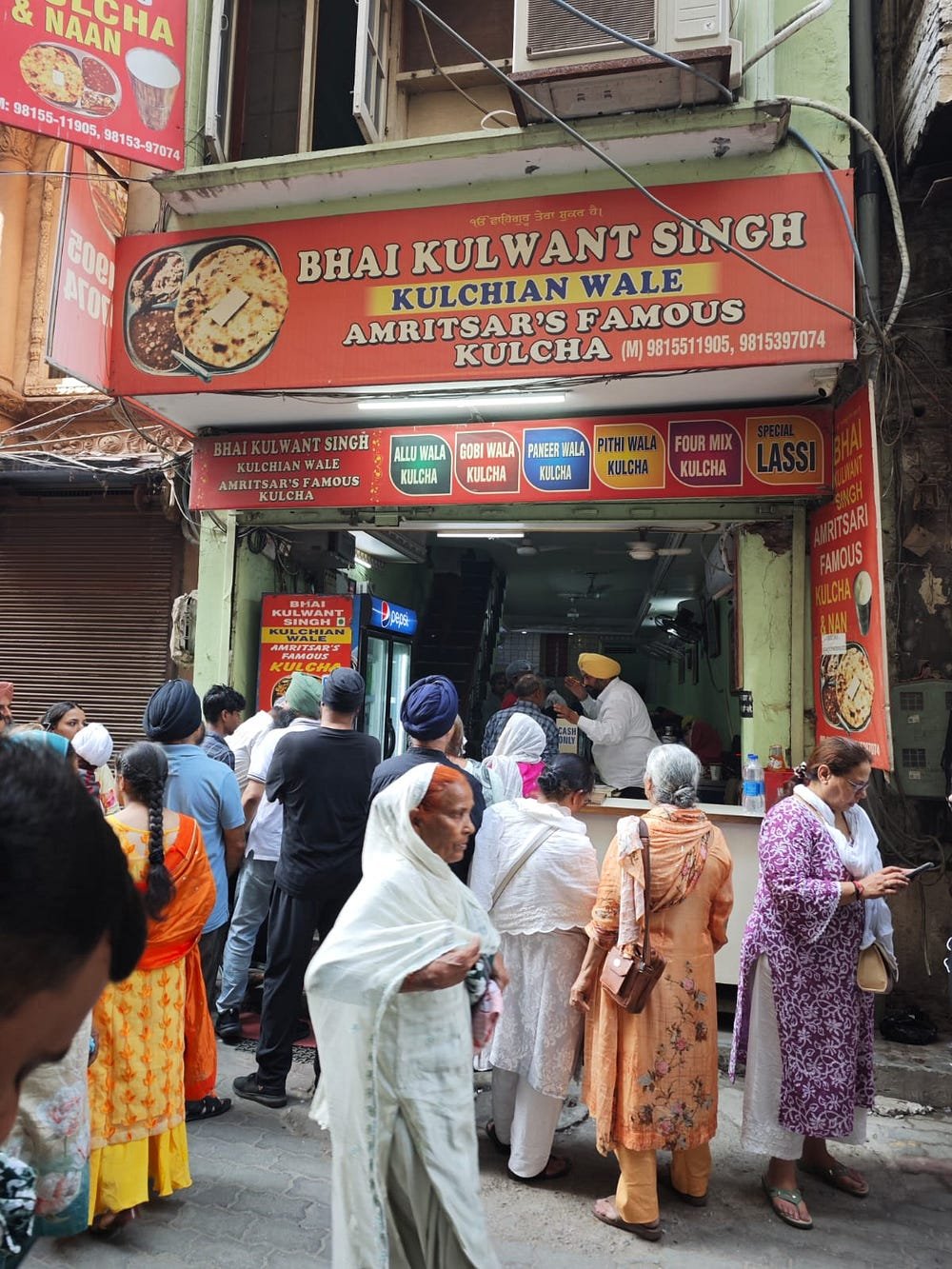
We tried aloo kulcha, gobhi kulcha, paneer kulcha, and mixed kulcha, and all of them were excellent. And after kulcha, lassi is a must. If you come to Punjab and do not drink lassi, then what was the point of coming to Punjab!
Now we were heading towards Jallianwala Bagh through the same narrow lane that was the only entrance at that time, the one we had often seen in Bollywood films. As we left the spiritual and peaceful atmosphere of the Golden Temple and reached Jallianwala Bagh, just a few steps away, the feeling of the surroundings changed completely.
There was beauty here, there was greenery too, and today it has been developed into a well-organised national memorial, but amid all of this, a strange sadness remained with us throughout.
This is the very place where, on 13 April 1919, on the day of Baisakhi, a large number of people had gathered, and British military officer “Brigadier General Reginald Dyer” entered the Bagh with his soldiers and ordered them to fire on the unarmed crowd without leaving them any safe way out. Hundreds of people were killed and a large number were injured, and this tragedy later came to be counted among the most important turning points in India’s struggle for independence.
Today, as we walk through the Bagh, history does not feel like merely written words; rather, it seems to stand before us at every step. The narrow entrance through which Dyer’s soldiers entered, the preserved wall on which bullet marks can still be seen today, and especially the Martyrs’ Well, into which many people jumped in an attempt to escape the bullets, seem to keep the horror of that incident alive even a century later.
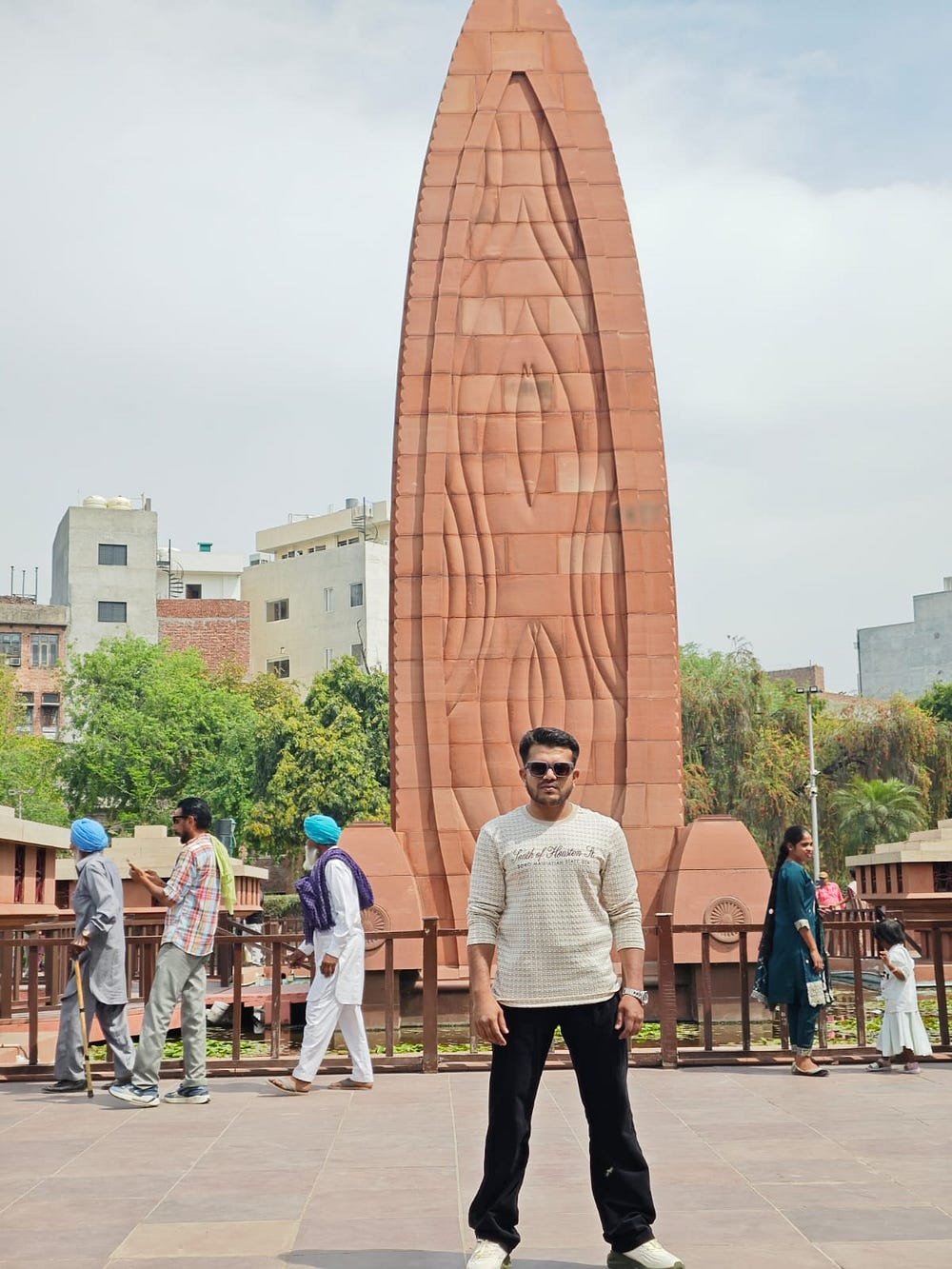
The memorial established in the Bagh, the Amar Jyoti, and the galleries related to the martyrs prevent this place from being merely a tourist attraction and instead turn it into a living memorial to the sacrifices made for India’s independence.
The Government of India formally designated it as the Jallianwala Bagh National Memorial and also enacted a law in 1951 for its preservation, while later its renovation, museum galleries, and other facilities were modernised.
Today, clean pathways, lush green gardens, and history presented in a modern way can be seen here, but the true significance of Jallianwala Bagh was not in its outward beauty.
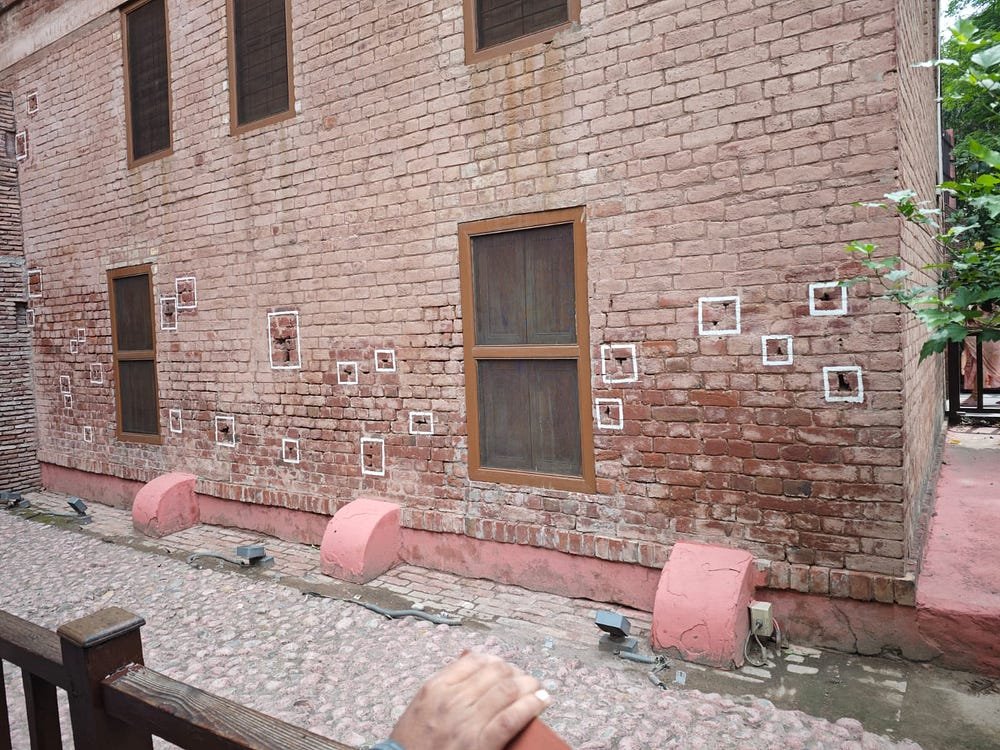
Its real impact is felt when we look at those bullet marks and the Martyrs’ Well and think that the very place where we are walking freely today was once a ground where unarmed people were not even left with a path to save their lives.
We had now set out towards the Wagah Border. This was our final stop in Punjab. After travelling approximately thirty kilometres from central Amritsar, when we reached the “Attari–Wagah Border,” the atmosphere here was completely different from that of the Golden Temple and Jallianwala Bagh.
This is the historic border point between India and Pakistan where the line drawn after the Partition of India still separates the two countries, but every evening this same border becomes the centre of an energetic ceremony for thousands of tourists.
The famous Beating Retreat Ceremony has been held here since 1959, in which India’s Border Security Force (BSF) and Pakistan’s Pakistan Rangers, on their respective sides, display a distinctive military style with brisk steps, high leg raises, parade movements, and salutes, and at sunset the national flags of both countries are lowered simultaneously.
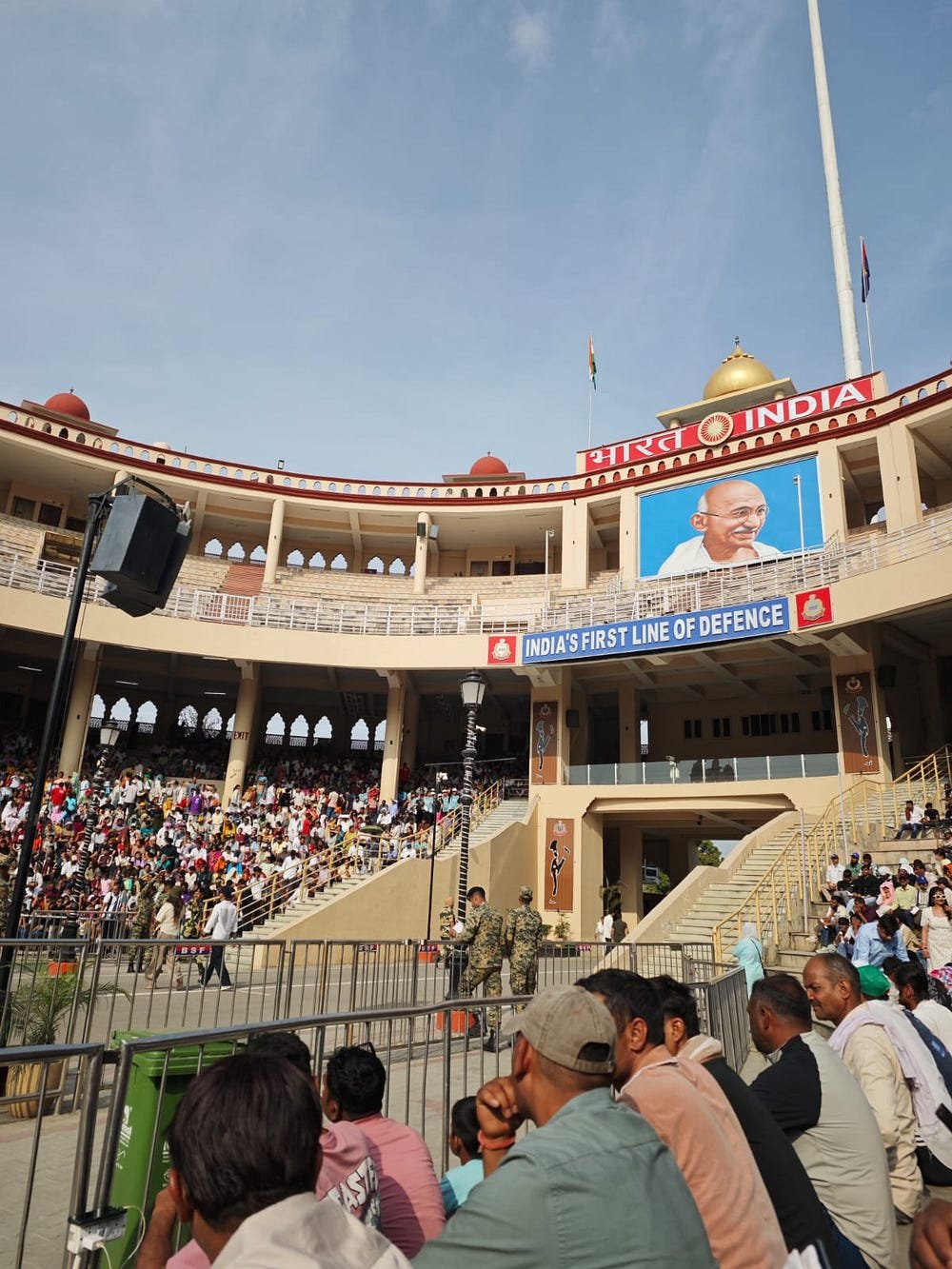
When we sat in the stadium-like enclosure filled with spectators, even before the ceremony began, the atmosphere had already taken the form of a grand national celebration. Patriotic songs were playing, people waving the tricolour were enthusiastically raising slogans, and with the arrival of the BSF personnel, the entire crowd erupted in applause and slogans.
During the main ceremony, the energetic march of the soldiers, the distinctive parade with extremely high steps, and finally the sight of both national flags being lowered simultaneously make this place far more than merely a border post.
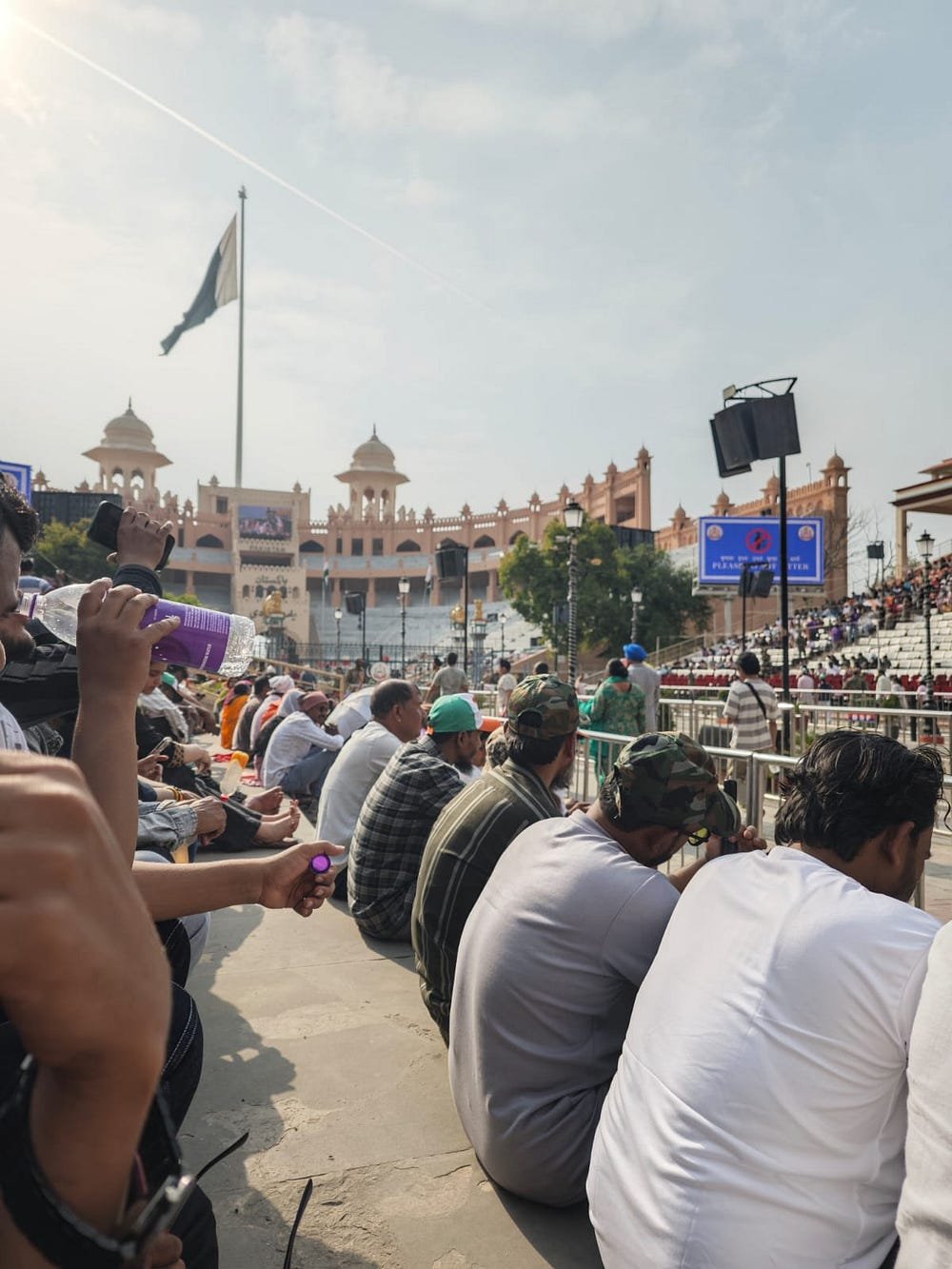
Even today, this ceremony is held daily for tourists, and in September 2026, its timings were changed again with the change in weather. The timing of the ceremony keeps changing according to the season and sunset. Therefore, it is better for visitors to check the latest timing beforehand.
Watching this entire scene with my own eyes,
the most interesting feeling for me was that on one side, just a few steps away, the land of Pakistan, its soldiers, and the people sitting there were clearly visible, while on the other side were we Indians. Between us stood only an iron gate and an international boundary line. Different flags on both sides, different slogans, and different national identities. Yet in the language, clothing, faces, and the shared culture of Punjab, a strange similarity was also clearly noticeable.
Perhaps that is why this evening at the Attari–Wagah Border did not remain merely a military parade or a tourist programme for me.
Instead, it became a unique experience of seeing, with my own eyes and at the same time, Partition, the border, nationality, and the two halves of the same historical and cultural region.