Why Don’t Muslims Need Gandhi and Nehru? From the controversy surrounding Asaduddin Owaisi’s statement about Gandhi and Nehru to the historically overlooked identities of figures such as Maulana Azad, Maulana Mahmood Hasan, and Maulana Mohammad Ali Jauhar. After all, how much room is there for Muslim leaders in the definition of Indian secularism?
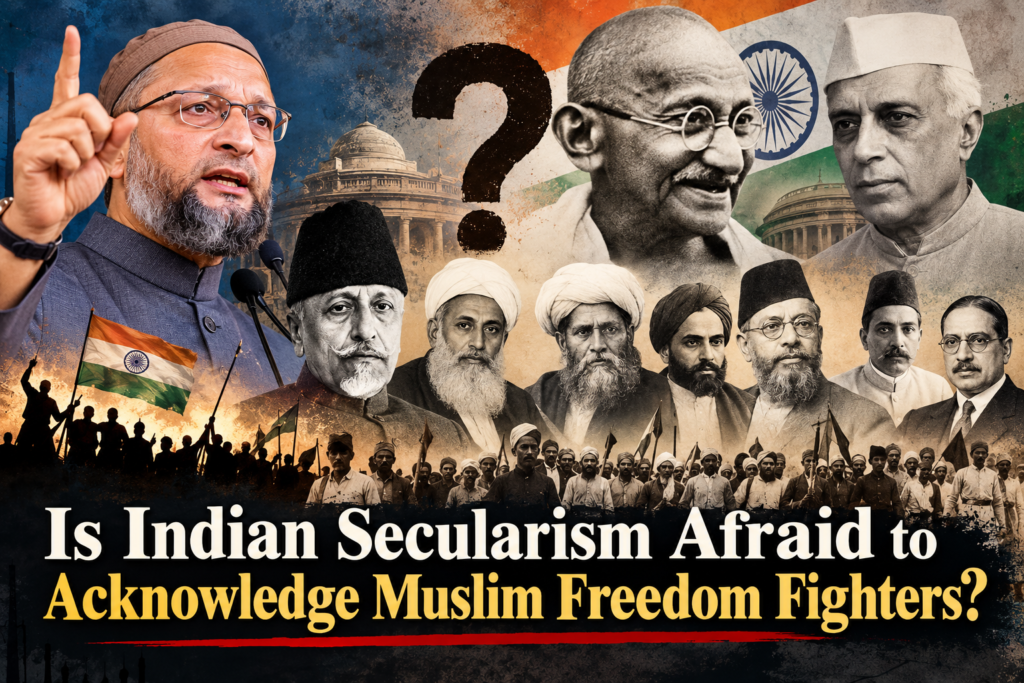
Muslims do not need Gandhi and Nehru. People who call themselves so-called secularists are presenting this statement by Asaduddin Owaisi by linking it to Mohammad Ali Jinnah.
After all, why don’t these people remember Maulana Abul Kalam Azad, Maulana Mahmood Hasan, Maulana Mohammad Ali Jauhar, Maulana Hussain Ahmad, Maulana Hifzur Rahman, Maulvi Ismail, Dr. Mukhtar Ahmad Ansari, and others? Why do these so-called secular people remember only Mohammad Ali Jinnah?
An uproar is being created over this statement by Asaduddin Owaisi. However, this is only half of his statement. This so-called secular section is leaving out the other half. These people have always done this. They are cunning and secular only for political purposes. In fact, I would call them fake secularists.
What did Asaduddin Owaisi say? Addressing a public gathering in Azamgarh, Uttar Pradesh, Asaduddin Owaisi said:
“Here, I see some people from our own ranks saying, ‘Oh Muslims, support them. Nehru and Gandhi will emerge from among them.’
Can’t a Maulana Azad emerge from among them?
Can’t a Mahmood Hasan emerge from among these people?
Can’t a Hifzur Rahman emerge from among them?
Can’t a Maulvi Ismail emerge from among them?
Can’t a Mohammad Ali Jauhar emerge from among them?
Can’t an Abid Sufrani emerge from among them?
Can’t freedom fighters emerge from among these people who sacrificed everything to free this country?
This is the difference between those people and Owaisi. They say, ‘Support them,’ while I say, ‘Become leaders yourselves.’ We are not anyone’s slaves, and if someone today claims to be the next Nehru or Gandhi, we are not going to run after them! Muslims do not need Gandhi and Nehru.”
This is Asaduddin Owaisi’s complete statement. But the so-called secular people are presenting it by linking it to Jinnah. Don’t Maulana Azad, Maulana Mahmood Hasan, Maulana Shaukat Ali, Maulana Hussain Ahmad Madani, Maulana Mohammad Ali Jauhar, and others belong to the secular camp? Why should only those who recognize Gandhi and Nehru be considered secular?
I have always noticed that whenever there is an opportunity to speak at an Independence Day or Republic Day celebration, these so-called secular people, if they are addressing Muslims, include Maulana Abul Kalam Azad and Ashfaqulla Khan alongside Gandhi and Nehru. But when the same people address non-Muslims, they do not even bother to mention a single Muslim freedom fighter.
After all, why do people who call themselves secular remember only Gandhi, Nehru, and Patel?
Why don’t they remember thousands of Muslim freedom fighters such as Maulana Mohammad Ali Jauhar, Maulana Mahmood Hasan, Maulana Hussain Ahmad Madani, Maulvi Ismail, and Dr. Mukhtar Ahmad Ansari? At most, they occasionally mention Maulana Abul Kalam Azad and Ashfaqulla Khan merely as a formality. And that too only when a significant number of Muslims are present in the audience. Otherwise, they do not even remember these two.
If you visit the office or headquarters of any political or social organization belonging to the non-Muslim secular camp, any institution, or the office of any non-Muslim secular political leader, secular social activist, or secular personality, look at the pictures hanging on the walls. You will find Gandhi, Nehru, Patel, Ambedkar, Bhagat Singh, and others.
If you visit the office or headquarters of any political or social organization belonging to the right-wing camp, any institution, or the office of any right-wing political leader or personality, you will find pictures of Patel, Shyama Prasad Mukherjee, Pandit Madan Mohan Malaviya, Savarkar, and others. In some places, you will also find Gandhi, Subhas Chandra Bose, Ambedkar, and Bhagat Singh alongside them.
If you visit any state institution, such as government offices, courts, schools, universities, and so on, you will also find pictures of Gandhi, Nehru, Patel, Ambedkar, Subhas Chandra Bose, Bhagat Singh, and others hanging on the walls. And if the government belongs to right-wing parties, you will also find Shyama Prasad Mukherjee, Pandit Madan Mohan Malaviya, and, in some places, Savarkar alongside them.
But the people whose pictures you will not find are Maulana Mohammad Ali Jauhar, Maulana Shaukat Ali, Maulana Mahmood Hasan, Maulana Hussain Ahmad Madani, Dr. Mukhtar Ahmad Ansari, Maulvi Ismail, Maulana Hifzur Rahman, and Aruna Asaf Ali. Only in very few places will you find pictures of Maulana Abul Kalam Azad and Ashfaqulla Khan.
Then where will you find Muslim freedom fighters? You will find them only in the offices and institutions of Muslim political and social organizations and in the offices of Muslim political and social personalities. You will find them in Muslim educational institutions. You will find them in Urdu schools, Muslim organizations, and the schools, colleges, and universities run by them.
Yes, there you will certainly also find pictures of Gandhi, Nehru, Patel, Ambedkar, Bhagat Singh, Rajendra Prasad, and others alongside them. Muslims do not discriminate among the freedom fighters who fought for the country’s independence.
They equally remember non-Muslim freedom fighters as well. But we see this difference in the majority community. And I am talking about the secular camps here. I do not even have any expectations from the right-wing camp.
But the same question remains: What difference is left between the secular camp and the right-wing camp?
On one side are Gandhi, Nehru, Patel, Ambedkar, Bhagat Singh, Rajendra Prasad, and others, while on the other side are Patel, Shyama Prasad Mukherjee, Savarkar, Madan Mohan Malaviya, and others.
In such a situation, if Asaduddin Owaisi also mentions Maulana Abul Kalam Azad, Maulana Mahmood Hasan, Maulana Mohammad Ali Jauhar, Maulvi Ismail, Maulana Hifzur Rahman, and others, how does that become wrong and extremist? How does it become a Jinnah-inspired ideology?
All these people, and indeed thousands of Islamic scholars like them, fought against the British solely and exclusively for India’s independence.
They issued fatwas calling for jihad and participated in jihad, to the extent that thousands of Muslims and their Islamic scholars were hanged. Some were imprisoned in Malta, while many were sentenced to Kala Pani.
Even so, why are people from the secular section associating Asaduddin Owaisi with Jinnah-inspired ideologies merely for mentioning these people?
If anyone opposed the idea of Pakistan and the creation of Pakistan more strongly than Gandhi, Nehru, and Patel, it was Muslims like Maulana Abul Kalam Azad and Maulana Hussain Ahmad Madani.
Even then, why are those who mention their names accused of being followers of Jinnah’s ideology?
How did Asaduddin Owaisi become a follower of Jinnah’s ideology and a communalist merely for forming an independent political party for his own community and people, fighting for their rights, raising his voice, and participating in elections?
In India, people belonging to every caste, community, and social group have their own political parties. Then why is the label of an extremist and communal party applied only to people like Asaduddin Owaisi and Badruddin Ajmal?
After all, why isn’t this label applied to Mayawati, Chandrashekhar Azad, Akhilesh Yadav, Tejashwi Yadav, Sharad Pawar, Hemant Soren, Prakash Ambedkar, and others? These people also engage in politics for their respective communities.
Asaduddin Owaisi is absolutely right.
Muslims do not need Gandhi and Nehru, but leaders like Maulana Abul Kalam Azad, Maulana Mahmood Hasan, Maulvi Ismail, and Maulana Mohammad Ali Jauhar.
Can those so-called secular people and those ignorant, foolish Muslims who are opposing this tell us whether, for Dalits, Gandhi and Nehru come first or the respected Dr. Ambedkar? Tell me, who comes first for them?
If Kanshi Ram Ji were alive today, who would come first for Dalits, Rahul Gandhi or Kanshi Ram?
Dalits have more political awareness than these foolish Muslims who are trying to prove how secular they are. At least they have Ambedkar and Kanshi Ram.
Ask any Dalit who their guiding light and source of inspiration is, Mahatma Gandhi or Mahatma Jyotirao Phule? Tell me, what would their answer be?
Ask any Hindu from South India whether Gandhi and Nehru come first for them or Periyar E. V. Ramasamy. Think about it and tell me what their answer would be!
For Muslims too, Maulana Abul Kalam Azad, Maulana Mahmood Hasan, and Maulana Mohammad Ali Jauhar will come before Gandhi and Nehru.
Why should Muslims be expected to place Gandhi and Nehru first to be considered secular?
Look at the picture below. Neha Bora and Dhruv Rathee.
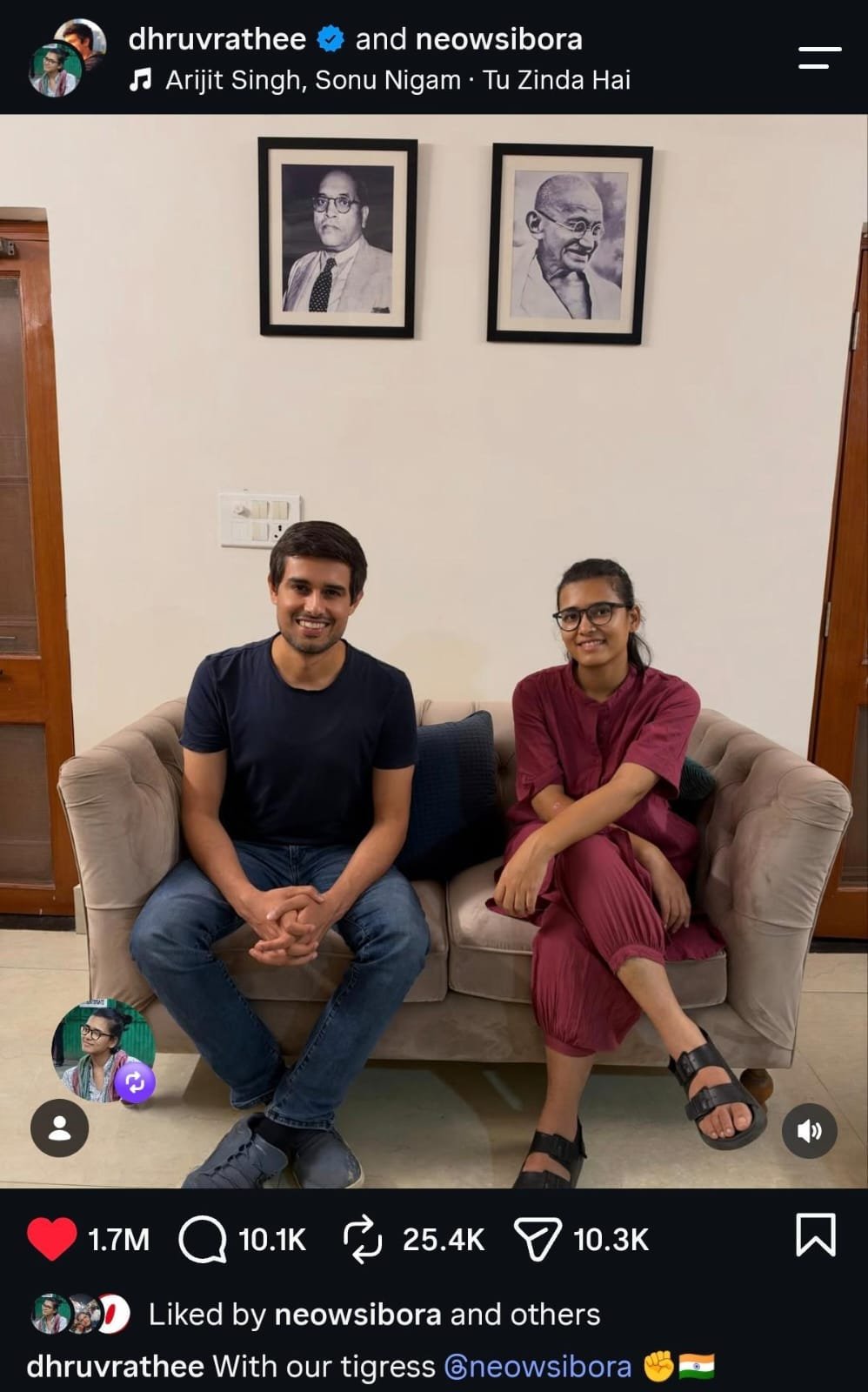
Both are more genuinely secular and honest than the so-called secular leaders of the so-called secular parties.
Even when it comes to Muslim issues, they are more sincere and outspoken than the Muslim leaders of the so-called secular parties.
But what I actually want to show in the picture is the two portraits hanging on the wall behind them. One is of Gandhi, and the other is of Bhimrao Ambedkar.
There is absolutely nothing wrong with this.
But the question arises:
What difference would it have made if there had been a third portrait of Maulana Abul Kalam Azad?
If even such ultra-pro-level secular people do not put up pictures of Muslim freedom fighters, then who else will?
It is not as though Maulana Abul Kalam Azad was not a leader of the same stature as Gandhi and Ambedkar. He spent more time in prison than Gandhi and Nehru. He was elected the youngest president of Congress and led Congress and the freedom struggle for the longest period, yet today his picture is nowhere to be seen.
In some places, there are pictures of Gandhi and Ambedkar, while in others, there are pictures of Gandhi and Nehru.
Somewhere, you will also find Gandhi and Bhagat Singh.
Elsewhere, you will find Gandhi and Subhas Chandra Bose.
In some places, pictures of Ambedkar and Bhagat Singh hang together.
But what is missing is the picture of Maulana Abul Kalam Azad.
Whether they even remember personalities like Maulana Mahmood Hasan, Maulana Hussain Ahmad, Maulvi Ismail, Maulana Mohammad Ali Jauhar, Aruna Asaf Ali, and Dr. Mukhtar Ahmad Ansari, I do not know.
The issue is not Asaduddin Owaisi’s statement at all.
The issue is the definition of secularism that has been limited to Gandhi, Nehru, and Ambedkar.
Just think about how normal the pictures of Gandhi and Ambedkar hanging on the wall behind Neha Bora and Dhruv Rathee seem according to the prevailing understanding of secularism. They seem so normal that nobody felt anything was wrong. Nobody even paid attention to them.
But what would have happened if there had been pictures of Gandhi and Maulana Abul Kalam Azad instead? Many people would have found it a little inappropriate, but they would have accepted it.
What would have happened if there had been pictures of Ambedkar and Maulana Abul Kalam Azad? Now, somewhat more people than before would have found it inappropriate and would have noticed it too.
And what would have happened if there had been pictures of Maulana Azad and Maulana Mohammad Ali Jauhar or Maulana Mahmood Hasan? Now even you would have found it inappropriate!
Even though all of them, just like Gandhi, Nehru, and Ambedkar, are among the greatest freedom fighters and leaders.
But if it still feels inappropriate, then the problem lies in the definition of secularism that has prevailed for years.
A definition that limits secularism merely to Gandhi, Nehru, and Ambedkar, while excluding personalities like Maulana Abul Kalam Azad, Maulana Mahmood Hasan, Maulana Mohammad Ali Jauhar, Maulana Hussain Ahmad, Aruna Asaf Ali, and Dr. Mukhtar Ahmad Ansari from the definition of secularism merely because they were Muslims.
Yet these were leaders who remained associated with secular ideologies and advocated them. In fact, several of them even served as presidents of Congress.
Therefore, the issue is not Asaduddin Owaisi’s statement at all.
The issue is the definition of secularism, because of which Asaduddin Owaisi’s statement feels inappropriate today.
In the true definition of secularism,
Gandhi may be the greatest leader for someone,
while Nehru may be the greatest leader for someone else.
For some, Ambedkar may be the greatest leader,
while for others, it may be Subhas Chandra Bose or Bhagat Singh.
For me, Maulana Abul Kalam Azad is the greatest leader.
Greater even than Gandhi, Nehru, and Ambedkar!
And I should have the freedom and the right to make that choice.
Only then is the definition of secularism genuine.
Otherwise, the definition of secularism that has prevailed for years is itself false.