
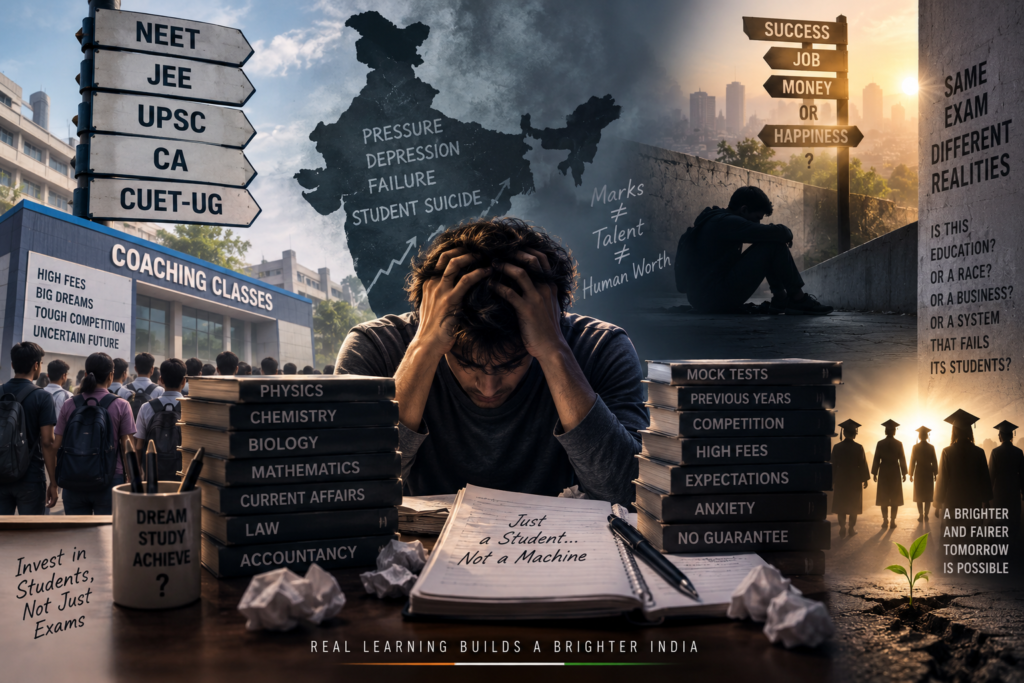
The coaching culture, NEET, JEE, UPSC, CA, and CUET-UG — a system where intense competition, economic status, and educational background are increasingly shaping a student’s future more than their actual talent and ability.
For centuries in India, education has been considered a means of moving forward on the path of economic and social progress. Today, if every ordinary or well-off person is educating their children and wants to educate them, it is only because, on the strength of that education, their child can get a good job and earn good money.
Not a single person’s purpose behind educating their children is to make them capable, bright, talented, sensible, able to understand right and wrong, able to decide what is right and wrong, or a good human being. The purpose is solely and entirely money.
Yes, it is certainly true that after acquiring knowledge, most children develop these qualities. But now, most children are being deprived of the opportunity to earn money and find employment through the knowledge they have acquired. Children who are unable to achieve the goal of earning money through education are considered failures by their parents, family, and society, even though they may have become well-mannered, capable, wise, and good human beings.
But when success and failure themselves are determined by money, qualities such as manners, culture, wisdom, and being a good human being are left far behind.
In India, the very idea that one should acquire knowledge because it will bring a good job, a good service position, good employment, and good money is completely wrong. People need to understand that the idea of acquiring knowledge for the purpose of earning money is completely wrong.
The biggest disease because of which lakhs of children in India are committing suicide today is precisely this: “acquiring knowledge to earn money.”
This is also why acquiring knowledge is becoming increasingly expensive in India. The education system has become a money-making factory. On one side are people who are buying education for their children because they want them to earn good money. On the other side are people who are earning money by selling good education.
The fees of schools, colleges, and universities are increasing day by day. Then expensive coaching classes, expensive study materials, and expensive online educational facilities have made education extremely difficult for poor and middle-class families.
For the purpose of getting good employment and earning good money, lakhs of families are compelled to buy expensive coaching classes, their expensive online facilities, and expensive study materials for their children so that they can get admission into good courses, good fields, and the country’s renowned universities and colleges.
Because this disease has been planted in their minds that through good education, prestigious fields and courses, and admission to famous and big-name universities and colleges, their child will become capable of earning good money. Otherwise, the child will remain poor, and the entire family will remain poor.
A fear was created and a hope was sold. Because of this fear, lakhs of Indian families are buying the hope of expensive education, expensive courses, expensive coaching classes, and their expensive premium study materials for their children, and are sinking into heavy debt.
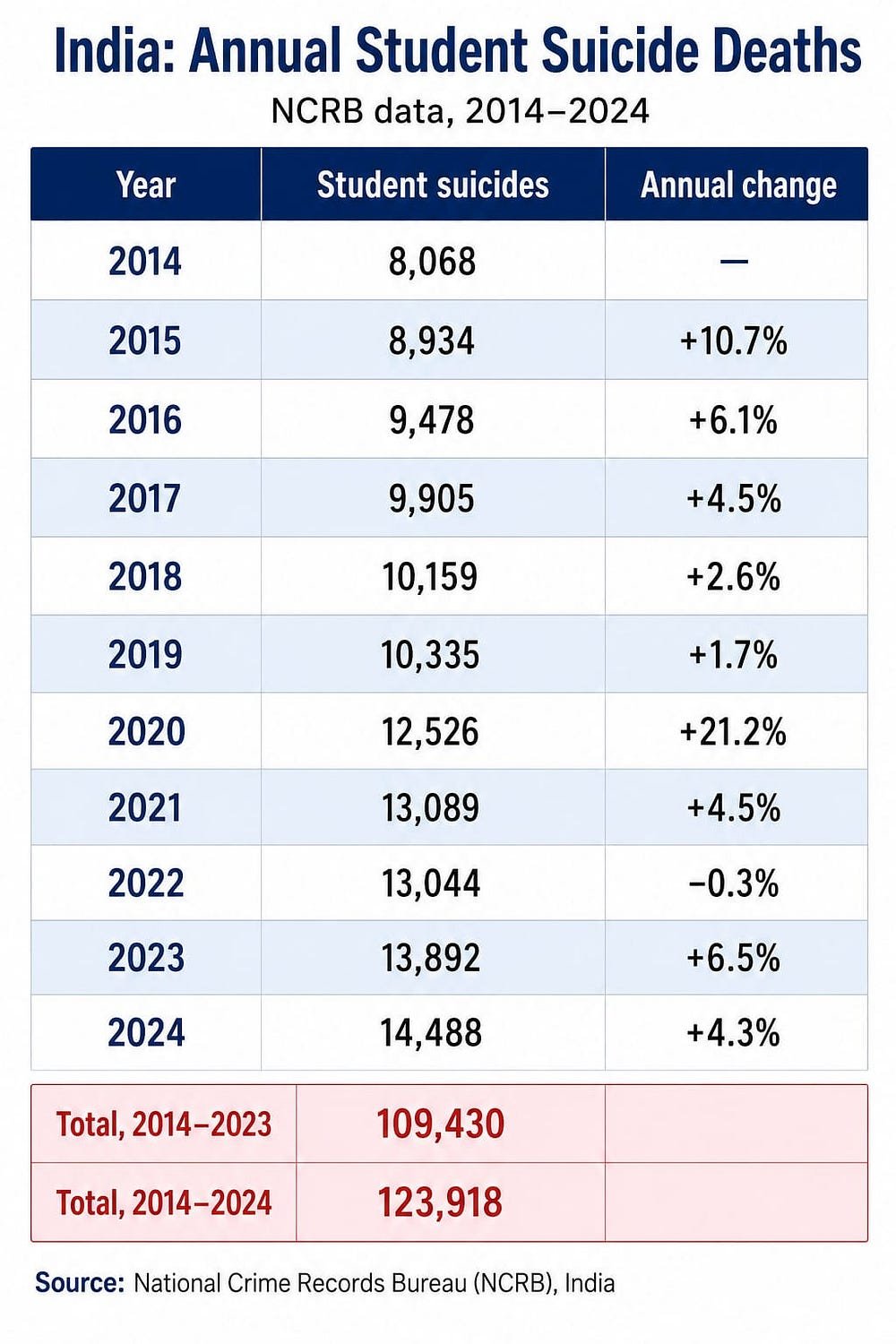
According to the National Crime Records Bureau, cases of student suicides have increased by 80 percent in the last ten years. In the last ten years, more than 120,000 students, and more than two thousand students every year, have committed suicide.
After all, what is the reason behind the increasing number of student suicides?
The biggest reason is the same disease that I mentioned above: “the purpose of earning money.”
When, after making so many efforts, students fail in competitive examinations, they feel that their entire future has been ruined.
Since their parents have taken heavy loans for their education, they also feel the burden of repaying that debt on their shoulders, and various negative thoughts and overthinking drive them toward suicide.
The second major reason, which is also a cause of the first reason, “failure,” is making competitive examinations compulsory for admission to further education after school, and then centralizing those competitive examinations.
The first competitive examination for admission to further education after school that has been centralized is the National Eligibility cum Entrance Test (NEET).
Its syllabus has been designed by the Central Board of Secondary Education (CBSE).
It is completely alien to 90 percent of the population because they have studied under the syllabuses of different state boards. Because of this, they are unable to score high marks in this examination and fail to get admission into the field, university, or college they want.
This is where expensive coaching classes and their expensive premium study materials become necessary. Even after repeating for another one or two years, only 5 percent of these students are able to succeed.
Most students belong to poor, lower-middle-class, and middle-class families. Expensive coaching classes are not possible for everyone. Then attending them for another one or two years is simply beyond their financial capacity; it breaks their backs economically.
And if some disaster occurs, such as a question paper being leaked, or an examination being cancelled without any reasonable cause or proper procedure, or the machine on which students are taking the examination malfunctioning or not working properly, even then the burden of lifting their family out of poverty falls on the students’ shoulders.
And despite all their efforts, they find themselves helpless and move toward suicide.
Did the student protests that took place across the entire country happen merely because the “Cockroach Janata Party” told them to protest?
Absolutely not!
This is the anger of students against a system that is preventing them from moving forward. Against a system that is taking away their family’s opportunity to escape poverty. A system that is pushing their parents into heavy debt.
Paper leaks or NEET are only examples. There are hundreds of such reasons that exist because of the system and its flaws, and the fire of opposition to them is burning in the hearts of students.
And this is not limited only to undergraduate and graduate levels. There are so many flaws in the system that even after graduation, there are problems in the admission process for master’s programmes, and after a master’s degree, all the way up to doctoral programmes, as well as flaws in the syllabus.
Universities have been handed over to inexperienced Sanghi vice-chancellors who keep creating separate problems, make changes to the syllabus according to the Sangh, run everything according to their own whims, and continue harassing students.
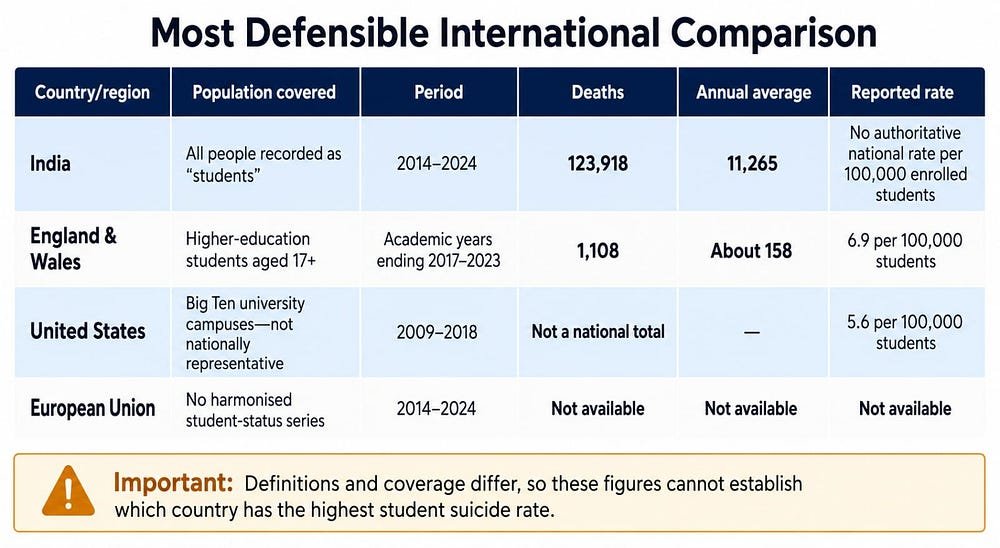
Do students not commit suicide in Europe and America? Of course they do. But compared with India, far fewer students commit suicide there. So is the reason that their syllabus is easy and India’s syllabus is extremely difficult? That is not the case either.
We often hear about Indian examinations that the NEET exam and the JEE exam are the world’s most difficult examinations, that the CA, GATE, and CAT exams are the world’s most difficult examinations, and that UPSC is the world’s most difficult examination. We hear this, don’t we?
If Indian examinations really are so extremely difficult, then those who pass them should also be the most talented people in the world, shouldn’t they?
Then why is it that students who pass such extremely difficult examinations are not among the world’s best doctors, engineers, scientists, economists, and bureaucrats?
Even today, the world’s best doctors, engineers, and scientists are coming from Europe, America, and China, and through their new inventions, they have brought revolutions to the world.
Just take AI today — where is India? Nowhere.
What about those top institutes of information and technology that we have declared to be among the world’s best institutes, and for admission to which students are dying?
Why are the people graduating from them not involved in making new inventions in the world of information and technology?
Why are students who gain admission through the world’s most difficult CUET-UG examination and study economics, and those who spend years passing the world’s most difficult UPSC examination, not the world’s best economists and the world’s best bureaucrats?
Why is our economic system faltering? Why are our bureaucrats failing to establish a better system in the country?
The answer is simply that neither are our examinations the world’s most difficult examinations, nor are our educational institutions the world’s best institutions, nor are our students the world’s most talented students.
They can be, if the system is corrected, if proper improvements are made to the syllabus, and if the education system and educational institutions are handed over to education experts.
ـــــــــــــــــــــــــــــــــــ
The second major problem is the centralization of competitive examinations.
Several states, especially Tamil Nadu, have already appealed that instead of NEET, further admissions should be granted on the basis of Class 12 board examination results.
But their appeals are continuously being ignored.
Centralizing competitive examinations may have some advantages, but its disadvantages are far greater.
Because when people belonging to different states, cultures, languages, environments, and regions have studied under different state and regional boards, conducting an examination based on CBSE is not fair at all.
The statistics make it clear that the centralization of the examination system harms the poor.
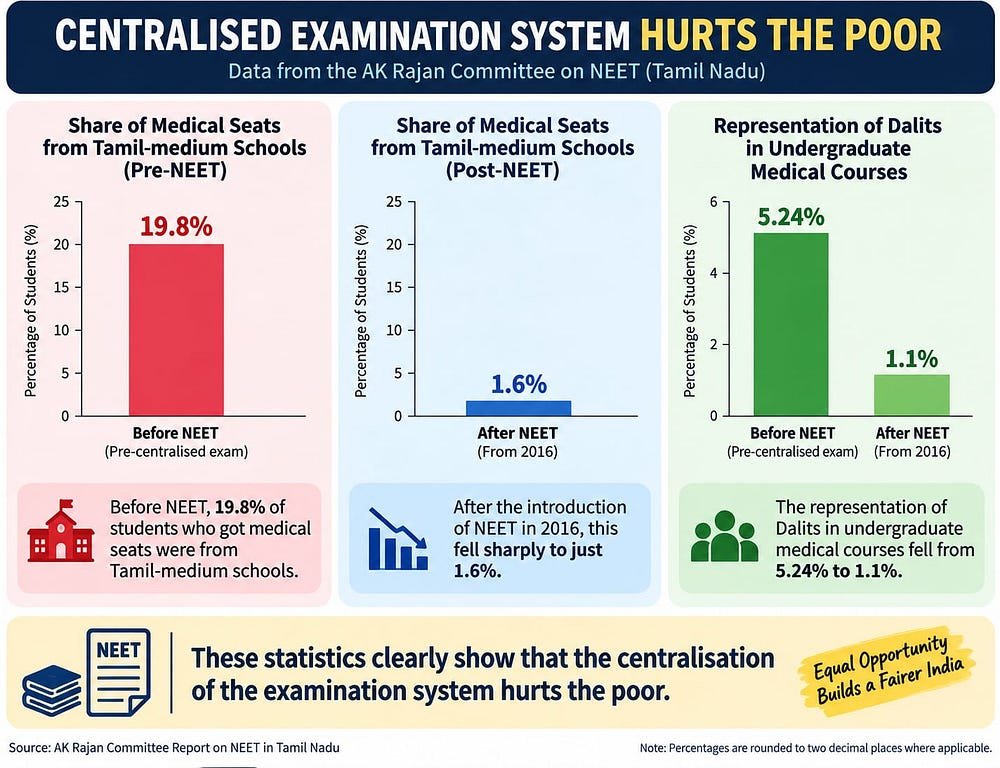
The “A.K. Rajan” Committee, established to study the impact of NEET in Tamil Nadu, pointed out in its report that before NEET, 19.8 percent of students securing medical seats came from Tamil-medium schools.
After the examination was introduced in 2016, this proportion fell to just 1.6 percent. The proportion of first-generation graduates in their families fell from 24.6 percent to 14.5 percent, while Dalit representation in undergraduate medical courses declined from a high of 5.24 percent to a low of 1.1 percent.
Let us understand through an example from Tamil Nadu itself why the graph of Tamil students is declining in the NEET examination being conducted on the basis of the central board.
On September 1, 2017, a 17-year-old daughter of a daily-wage labourer from Tamil Nadu, “Shanmugam Anitha,” committed suicide. Despite living in extreme poverty and not even having a toilet in her home, she worked extremely hard day and night and performed brilliantly in the state’s Class 12 board examination, scoring 1,176 out of 1,200 marks. However, because of NEET’s unfamiliar syllabus, she scored only 86 marks out of 700.
When the state government challenged the examination in the Supreme Court, Anitha also became a party to the case.
When the court ruled that only NEET would apply to the state’s medical colleges, she ended her life.
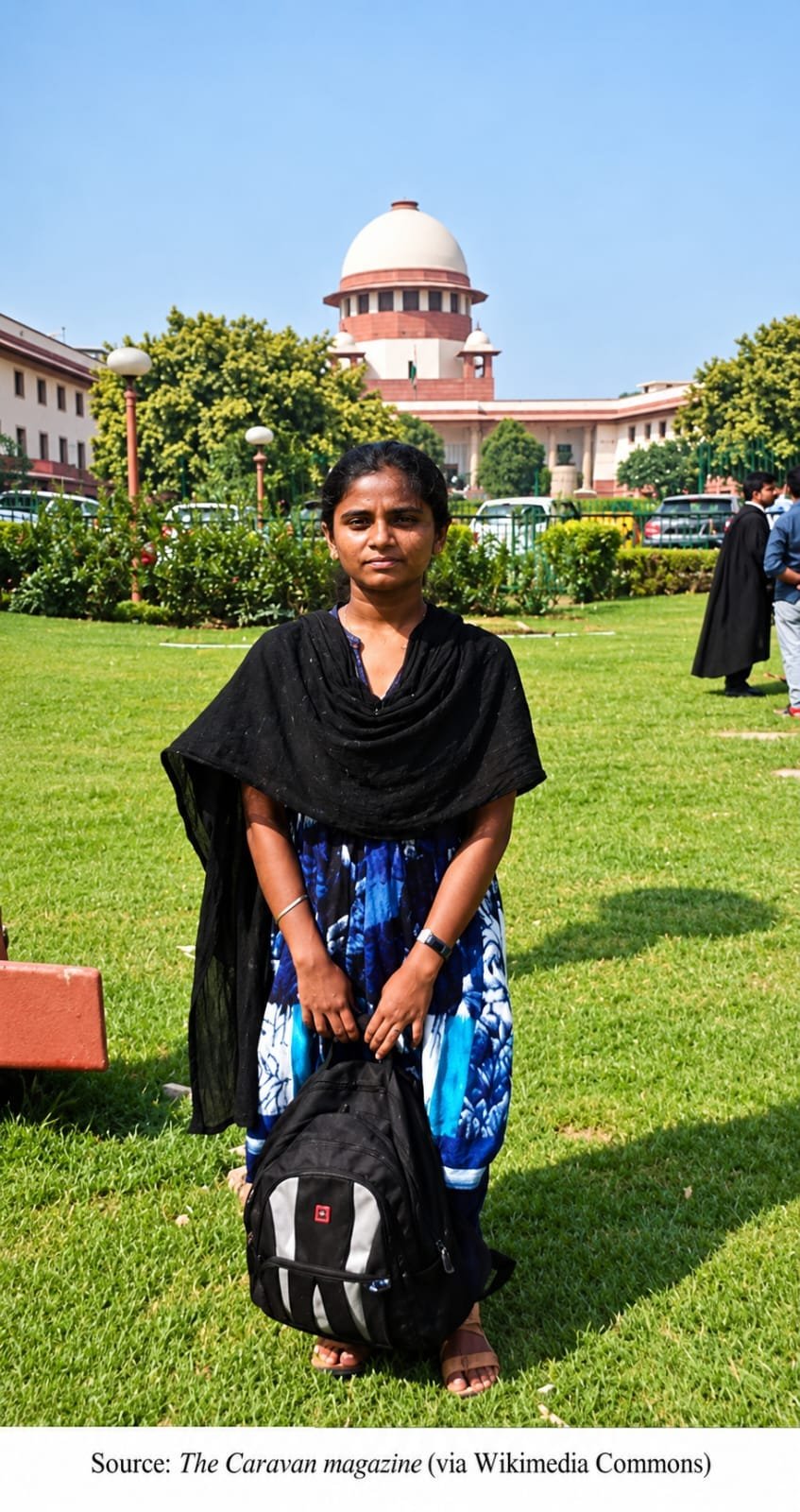
And this is not only about Tamil Nadu. Students from many states are going through this. They are compelled to take expensive coaching classes and online coaching classes that are specifically designed for competitive examinations conducted under the central board.
Even then, a few days of classes do not change much, so they have to repeat these expensive coaching classes for one or two years, which is not within everyone’s means, especially in a country where 90 percent of the population lives below the poverty line.
ــــــــــــــــــــــــــــــــ
For a long time in America, white students generally performed better than Black students in the prevailing intelligence tests. In some circles, this difference was presented as though Black students were naturally less intelligent or less capable than white students.
But African American psychologist “Dr. Robert L. Williams” raised a very interesting question against this assumption:
if the examination itself is designed according to the language, culture, and social experiences of a particular group, can the results of that examination truly be regarded purely as a measure of intelligence?
To examine this question, Williams developed the Black Intelligence Test of Cultural Homogeneity (BITCH-100) in the early 1970s. The hundred questions in this test were designed against the background of African Americans’ language, vocabulary, culture, and social experiences.
When it was tested on Black and white American students, the result was the opposite of the prevailing tests: Black students performed significantly better than white students.
The purpose of this experiment was not to prove that Black students were more intelligent than white students. The real point was far more important:
“Success in an examination is not always solely the result of intelligence. The standard of the examination, language, educational background, and familiarity with the questions can also affect the results.”
This incident raises an important question before us when discussing India’s centralized competitive entrance examinations.
India is not a uniform educational, linguistic, and social unit. Different states have their own educational boards, languages, teaching methods, and educational environments.
In such a situation, if crores of students coming from different educational backgrounds are judged by the standard of a single central examination, how fair would it be to judge a student’s intelligence or ability merely on the basis of examination results?
Perhaps the problem is not with the student’s intelligence, but with the standard being used to measure that intelligence.
The lesson of Robert Williams’s experiment was also this:
when the standard changes, sometimes the ranking of intelligence changes as well.
Therefore, to label a student from a state board, regional-language background, or different educational background as less intelligent merely because they fall behind in examinations such as NEET or JEE can be a serious intellectual mistake.
ـــــــــــــــــــــــــــــــــــــــــــ
I want to tell students not to move toward education with the purpose of earning money, otherwise you will continue to find yourselves distressed like this.
One thing that I have noticed is that students in Western countries start doing some work alongside their studies — something they like and something that also begins to generate some income. In other words, a “side hustle.”
From their student days themselves, they start doing one thing or another, such as tutoring, freelance writing, virtual assistant work, UGC content creation, social media management, selling digital products, print on demand, affiliate marketing, user testing, and skill-based services such as graphic design and video editing, healthcare and fitness training, writing, software development, and the positive use of YouTube and Instagram, etc. These are all common and useful side hustles for students there.
Whereas our Indian students, for as long as they are studying — meaning until they are twenty to twenty-five years old — limit themselves solely to acquiring education and make themselves dependent on that education alone for building their future.
Although things are gradually changing now. Looking at LinkedIn, YouTube, and Instagram, it becomes clear that students in India have also started doing side hustles alongside their studies. And that is a good thing.
Times have changed today. Internet access is also cheap in India, and the world’s largest audience lives in India itself. Therefore, all students should do something alongside acquiring their education.
Online tutoring, freelance writing, Canva designing, social media management, video editing, selling notes and study materials, campus ambassador work, affiliate marketing, reselling, data entry, small online projects, content creation, etc. — these are all good side hustles that students can do alongside their studies.
Today, content creation is at its boom in India, and it is being said that
by 2030 it will rise so much that every person will create content on social media — either by choice, because of necessity, or because they are compelled to do so.
From your student days itself, you can showcase your talent, your hobby, and your skills on Instagram, YouTube, and LinkedIn. You will find customers and viewers there, and you will start earning from the very beginning.
There are many platforms, many apps, and websites from which you can learn. You can teach others yourself. Your skills, your products — especially digital products such as templates, notes, thumbnails, writings, video editing, graphic design, makeovers, mehndi designs, blogging, vlogging — anything and everything that you know how to do. Just do a little research. Understand the process a little, learn a little, and get started.
Because until the Indian education system is reformed, your dream of improving your future solely on the basis of your education will also remain incomplete somewhere or another.
It is not without reason that crores of people in India are unemployed. It is not that they are incapable; there is no shortage of talent among them either. But they also made the same mistake that you students are making today:
the goal of earning money on the basis of education and the dream of building a better future through it.
And this is something one does not understand during one’s student days. But those who do understand it certainly move forward by doing one thing or another.
References & Sources
1. National Crime Records Bureau (NCRB), Government of India
Accidental Deaths & Suicides in India (ADSI)
https://ncrb.gov.in/
2. Justice A.K. Rajan Committee, Government of Tamil Nadu
Report of the High-Level Committee to Study the Impact of NEET on Medical Admissions in Tamil Nadu
https://tnhealth.tn.gov.in/online_notification/notification/N21092966.pdf
3. Robert L. Williams — Black Intelligence Test of Cultural Homogeneity
The BITCH-100: A Culture-Specific Test — ERIC (Education Resources Information Center)
https://eric.ed.gov/?id=ED070799
4. The Caravan magazine, August 2026 Issue
How the NEP’s killing of the public university brought Gen Z out on the streets
By “Eram Agha”