Democrats have gained control of Congress, while Dr. Abdul Sayed has become the first Muslim Senator, and Muslim candidates have set new records at the federal, state, and local levels.
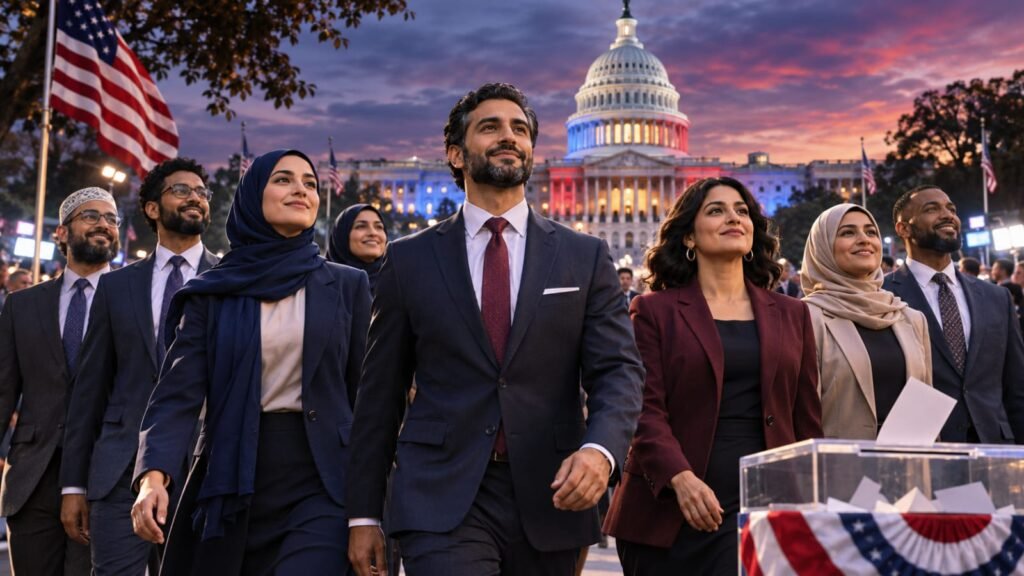
The US midterm elections are being widely discussed around the world. America has an influence on the entire world, so any kind of change that takes place there also affects the whole world.
There are some important things that you should also know so that you can understand the direction in which the world is moving at this time.
Just as India has the Lok Sabha and Rajya Sabha, and these two houses are collectively called Parliament, similarly, in America, there is the House of Representatives instead of the Lok Sabha and the Senate instead of the Rajya Sabha, while Parliament is called Congress.
American elections are slightly different from Indian elections. In India, elections for membership in the Lok Sabha are held every five years. Then, the party whose members win the most seats gets to form the government, and its leader becomes the Prime Minister. This is not how it works in America.
America has a presidential system. The President is elected every four years through a unique electoral process in which the people participate. And two years into every President’s four-year term, elections are held for the House of Representatives and the Senate, which we know as midterm elections.
The members of both houses of the US Congress, meaning the American Parliament, are also elected by the people. The President can belong to one party. The House of Representatives, which is equivalent to the Lok Sabha, can be controlled by another party. The Senate, which is equivalent to the Rajya Sabha, can be controlled by yet another party. Similarly, elections are also held for state governors, and governors are elected by the people.
The US House of Representatives has 435 seats, for which elections are held every two years. The US Senate has 100 seats. Although Senators serve six-year terms, because their terms are staggered, one-third of the members complete their six-year terms every two years, and elections are held for those seats.
When Donald Trump was elected President, his own party, the Republican Party, controlled both the House of Representatives and the Senate. Trump could do whatever he wanted, and he did.
But now, after the midterm elections, the situation has changed. Both the House of Representatives and the Senate are now controlled by his opposing party, the Democratic Party.
This means that even though Trump still has his presidential powers, he will no longer be able to do whatever he wants. He will now have to seek approval from the US Congress.
Earlier, because his own party controlled both houses of Congress, he could act as he pleased, and Congress remained silent. But now, with the opposition party controlling both houses of Congress, it is as though his hands have been tied. This is why the US midterm elections are being discussed so widely today.
The 2026 US midterm elections proved to be not merely a routine transfer of power but a clear public reaction against President Donald Trump and the Republican Party.
The Democratic Party secured a majority in the House of Representatives by crossing the required threshold of 218 seats and also captured at least seven Republican seats in the Senate, taking control of both houses of Congress.
The most surprising results came from traditionally Republican states such as Texas, Kansas, Iowa, and South Carolina, where James Talarico, Adam Hamilton, Josh Turek, and Annie Andrews, respectively, delivered historic victories for the Democratic Party.
In North Carolina, Roy Cooper, in Maine, Troy Jackson, and in Ohio, Sherrod Brown also captured important Republican seats, while Democrats successfully defended their difficult seats in Michigan, Georgia, Minnesota, and New Hampshire.
In the gubernatorial elections as well, Democrats ended Republican rule in Georgia, Iowa, Ohio, and Texas. The victory of Keisha Lance Bottoms in Georgia was particularly historic because she became the first Black woman to be elected governor of a US state.
Inflation, the cost of everyday living, the Iran war, government corruption, and growing dissatisfaction with the Trump administration’s style of governance turned this election into a Democratic wave that completely changed the balance of power in Washington.
The most historic and far-reaching aspect of these elections was the extraordinary success of American Muslims. Democratic candidate Dr. Abdulrahman El-Sayed defeated Republican candidate Mike Rogers in Michigan, earning the distinction of becoming the first Muslim Senator in American history.
Dr. Abdulrahman El-Sayed was a particular target of Trump. Trump openly called him a jihadist.
And on October 25, at a rally in Michigan, he even went so far as to say:
“He will be the only Senator who will have to pass through a metal detector (a device used to detect metal weapons) before being allowed to enter the Senate. I want a metal detector installed for him.”
On October 29, Dr. Abdulrahman El-Sayed gave such a response to Trump’s boastful remarks that the whole of America erupted in laughter. Dr. Abdulrahman El-Sayed said:
“Donald, let’s settle this matter this way: I will walk through a metal detector every day, provided you sit in front of a lie detector once. I have nothing to hide; you have a lot to hide. My first question to you will be about Epstein, and the second will be whether you won the 2020 presidential election.”
The son of Egyptian immigrants, a doctor, epidemiologist, and former public health official, Abdulrahman El-Sayed achieved victory in an important swing state despite an intense anti-Islam campaign, outside financial interference, and attacks on his religious identity.
Therefore, his victory is not merely the triumph of an individual or a political party but a major step forward in the national political acceptance of American Muslims.
In the House of Representatives, Dr. Adam Hamawy defeated Republican Gregg Mele in New Jersey’s 12th District, becoming the first Muslim from New Jersey to reach Congress.
He is a doctor, former military officer, and war trauma surgeon who served in Iraq and has also provided medical services in several war-torn regions, including Gaza.
From New York’s 13th District, Darializa Avila Chevalier defeated Republican Jomo Williams by a large margin, achieving the historic distinction of becoming the first Latina Muslim woman to enter Congress.
The daughter of Dominican immigrants, a social activist, and a supporter of Palestinian rights, Chevalier’s victory has brought Latino, Muslim, and progressive political movements together at a new point of intersection.
Similarly, Ilhan Omar, of Somali origin, was elected for the fifth time from Minnesota’s 5th District, while Rashida Tlaib, of Palestinian origin, once again secured a landslide victory from Michigan’s 12th District.
André Carson maintained his long-standing presence in Congress from Indiana’s 7th District, while well-known civil rights activist Lateefah Simon was re-elected from California’s 12th District.
Thus, seven Muslims, including one Muslim Senator and at least six Muslim members of the House of Representatives, successfully reached Congress.
Beyond the federal level, Muslim candidates have also made new history. Minnesota Attorney General Keith Ellison was re-elected.
In New York, Aber Kawas became the first woman of Palestinian origin and the first Muslim woman to enter the state legislature.
Nabeela Syed flipped a Republican Senate seat in Illinois, while in Texas, Letitia Plummer was elected Chief Executive of Harris County, becoming the highest-ranking Muslim woman official in the state.
According to preliminary figures, at least 97 Muslim candidates won elections across federal, state, judicial, municipal, and educational institutions, significantly more than the 82 Muslim winners in 2022.
These victories show that American Muslims are no longer limited to representing a particular religious or ethnic community.
From the Senate to the courts, city governments, and school boards, they are becoming a regular part of American decision-making.
And the 2026 election has proved to be a historic turning point in the journey of American Muslim politics, moving beyond representation toward achieving real political influence.