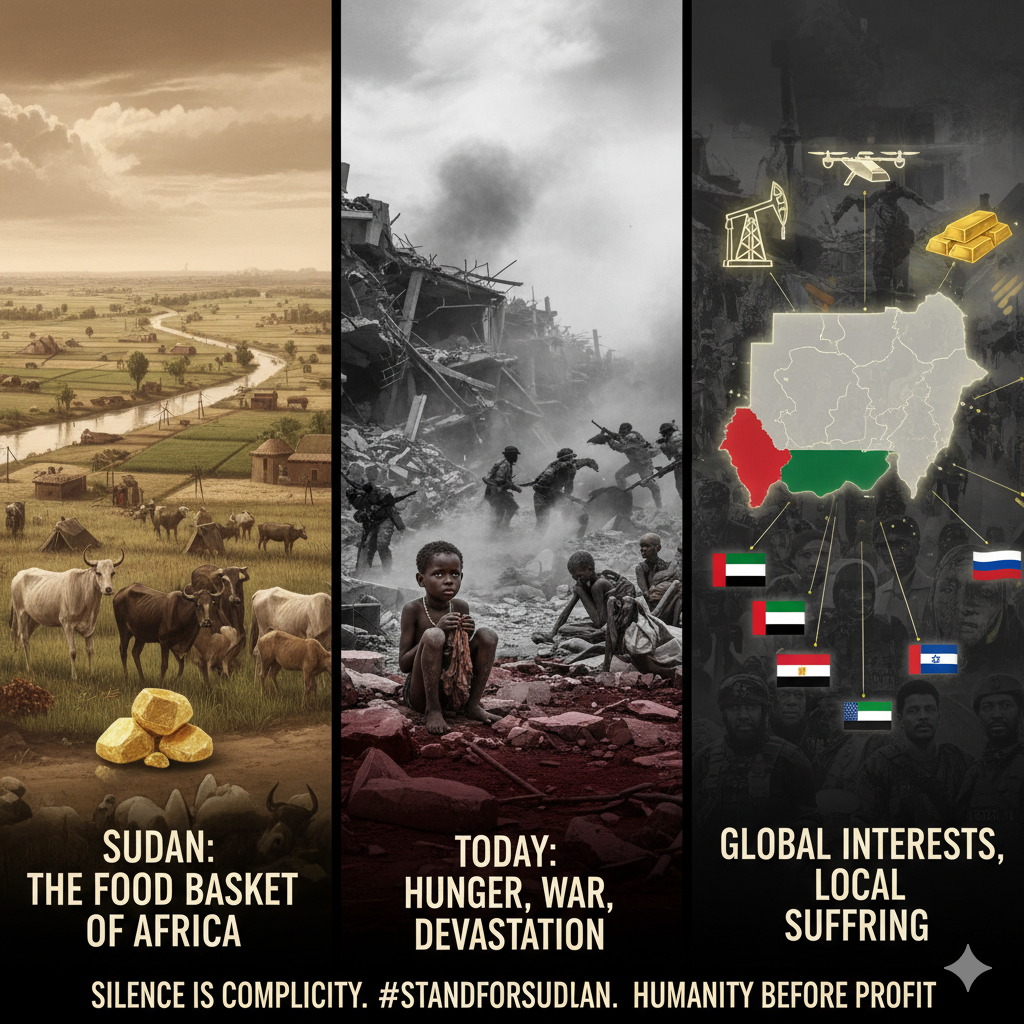
Sudan is the country that was once called the “Food Basket of Africa,” its lands irrigated by the waters of the Nile, where the world’s largest agricultural project, the Gezira Scheme, was established. That same Sudan ranked third in the world in terms of gold reserves and stood fifth in the number of livestock.
But today that same country presents a picture of hunger, famine, civil war, and devastation. According to the United Nations, more than ten million Sudanese are currently on the brink of severe food shortages and famine. The question is: why is this country — rich in natural resources — today drenched in blood and dust?
Sudan’s current civil war began in April 2023, when the country’s two powerful military forces turned against each other.
On one side are Sudan’s professional armed forces (Sudanese Armed Forces — SAF) and on the other the Rapid Support Forces (RSF), also called #Janjaweed. This fight is actually a battle for power, military supremacy, and control over the country’s political and economic resources.
The background is as follows:
In 2019, following public protests that led to the end of President Omar al-Bashir’s three-decade rule, a transitional military-civilian government was established. But soon the struggle for power began. Disagreements between Army Chief Abdel Fattah al-Burhan and the head of the Rapid Support Forces, Mohammed Hamdan Dagalo (Hemetti), over the division of power, integration of the forces, and the future shape of government pushed the country toward civil war.
In the early days this fighting was limited to Khartoum and its outskirts, but it soon spread across the country. In particular, in the western region of Darfur the conflict took on an ethnic character. As a result, the city of Al-Fashir in Darfur — once considered a center of peace — has now become a ruin.
It should also be clear that the RSF militia was not originally part of the army, but a band of tribal armed fighters. When the movement against Omar al-Bashir began in 2019, they obtained his support to save his rule and were given a semi-military status. Their leader Hemetti was made a pseudo-general. Their militia was named the Rapid Support Forces.
In April 2019, after Omar al-Bashir was imprisoned, General Abdel Fattah al-Burhan and his fellow military officers took power. They established a Transitional Military Council. The public accepted it temporarily, but soon demanded that power be handed over to a civilian government. Protests began across the country. An alliance emerged under the name “Forces of Freedom and Change” (FFC), which demanded the establishment of a civilian government. The military initially resisted, but due to international pressure and domestic protests, in August 2019 they agreed to a power-sharing government. That government consisted of both military and civilian leaders.
Abdalla Hamdok became prime minister, while General al-Burhan remained the military chief. During this period Sudan restored international relations, particularly with the United States, and was removed from the “terrorism list.”
Then in October 2021 General al-Burhan suddenly staged a coup and dissolved the civilian government. Prime Minister Hamdok was placed under house arrest. The military took control of the entire country, and from here the foundations of the new civil war were laid.
During the transitional period the Rapid Support Forces (RSF) also emerged as a new military power. This force had previously been active in the wars of Darfur, but was later given a semi-official status. Over time the struggle for power between the regular army and this militia increased, especially over the issue of integration into the army. Then in April 2023 the disagreement turned into open warfare.
The capital Khartoum was devastated. In Al-Fashir city the situation became akin to the worst genocidal scenes, and more than ten million people were displaced. In other words, the end of Omar al-Bashir’s regime in 2019 was a hope for “freedom,” but today that hope has turned into “anarchy.”
According to informed sources, the Rapid Support Forces have committed crimes such as mass killings of civilians, looting, and burning villages. At present the massacre in Al-Fashir continues. The city had been under the control of the Sudanese army. From outside, the Rapid [Forces] had besieged the city. This siege had been ongoing for 600 days, as a result of which the locals were forced to eat even carcasses. But recently, after fierce fighting, the army had to retreat and evacuate the city. After that, the RSF militia fighters entered the city and began the massacres.
Hospitals have seen piles of corpses and harrowing images of children dying of hunger.
Foreign intervention and interests?
Foreign powers have deep interests in Sudan’s civil war.
Geographically, this country is located at the mouth of the Red Sea — the same route that is the trade artery between the Middle East, Africa, and Europe. This location has turned Sudan into a playground for global powers.
The United Arab Emirates (UAE) is openly or covertly supporting the Rapid Support Forces (RSF). Several consignments of weapons supplied by it have been seized by the army. On the basis of this concrete evidence the Sudanese government has even filed a case against the UAE in an international court. The UAE’s interest in Sudan includes gold mines, agricultural lands, and seaports. Emirati companies have been exporting gold illegally from Darfur and northern regions, in exchange for which the RSF received weapons and financial support.
On the other hand, Egypt stands behind the Sudanese army (SAF) because it fears that if a semi-military group succeeds, the distribution of Nile waters could be jeopardized for Egypt.
Saudi Arabia, while apparently engaged in mediation efforts, secretly desires a political arrangement that would be allied to and compliant with it.
Russian involvement in Sudan is also not hidden. Russia’s objective is clear: it wants to establish a permanent naval base on the Red Sea coast. Russia’s private mercenary company, the Wagner Group, has already been active in Sudan’s gold trade.
Where there is civil war or tension, how could the United States and Israel remain behind? They are not mere spectators in this game but players.
The U.S. interest is that Sudan, by no means, should move closer to Russia or China.
While Israel — with which the process of restoring relations began after Omar al-Bashir — wants to make Sudan its new ally in East Africa so as to limit Iranian influence in the Red Sea.
Israeli intelligence in the past made direct contacts with RSF leaders, and according to reports Tel Aviv tried through Cairo to influence both parties on multiple occasions.
Division of the country?
The recent civil war in Sudan has also increased the risk of the country’s division, and many observers view this as a possible outcome, although no party has formally declared a split.
At present northern and eastern Sudan (which includes Port Sudan) is under army control. The western regions, especially Darfur and Al-Fashir, are under RSF control.
If the war continues, Sudan could be divided into two or three parts. The north would be under the army’s influence, the west under Hemetti’s militia, and the eastern port area (Port Sudan) might come under some form of international supervision.
Thus, Sudan today is not only fighting a war for power but also a fight for existence and survival. This country has already been divided before into South Sudan and northern Sudan.
The result? Public devastation!
According to the United Nations, more than twelve thousand people have been killed so far and over 1.4 million have been displaced. Hospitals across the country are destroyed, food deliveries have stopped, and drinking water has become scarce.
Cities like Al-Fashir, Nyala, and El Geneina present scenes of human catastrophe. The people suffering between the warlords fighting over gold, oil, land, and power are now dying from famine and disease.
There was a time when Sudan was called “the future of Africa.” Fertile land, mineral resources, vast livestock farms, and the blessings of the Nile — all of these have today been consumed in the flames of war.
Where green fields once waved, there is now the smell of gunpowder. Where children once played under the shade of date palms, the cries of mothers now echo.
In short, the real fuel of this war of interests is the blood of the poor people.
In truth, whatever is happening in Sudan today is a disgrace to humanity. A hundred, five hundred years ago we used to see such killing and looting, but today — when we live in an era of developed and civilized societies — why is there still the same killing and destruction?
Isn’t this shameful for humanity? Then what have we achieved if even today humans are killing humans in such a way that even animals and beasts would be ashamed to see it!
This should not happen at all. All of us — the people of the whole world — must rise up so that no one is oppressed anywhere. Neither in Gaza, nor in Sudan, nor in any region of the world.
Whoever the oppressor may be, they should be stopped; the people should stand up against them.
Ordinary citizens around the world must protest and raise their voices so that the reins on oppression are tightened. After all, personal and national interests, wealth, and natural resources are not greater than human life.
The United Arab Emirates, Israel, and all those countries involved in the massacre of humanity must stop immediately.
Raise your voice for Sudan; try to save the innocent, helpless civilians from massacre.