In Madhya Pradesh, Rajasthan, Haryana, Maharashtra, and now Bihar, the BJP launched a government scheme under different names before the elections, under which money was transferred every month to the bank accounts of women in those states. Then the elections took place, and the BJP registered a one-sided victory in Madhya Pradesh, Haryana, and Maharashtra. The credit for this victory was attributed to this very scheme.
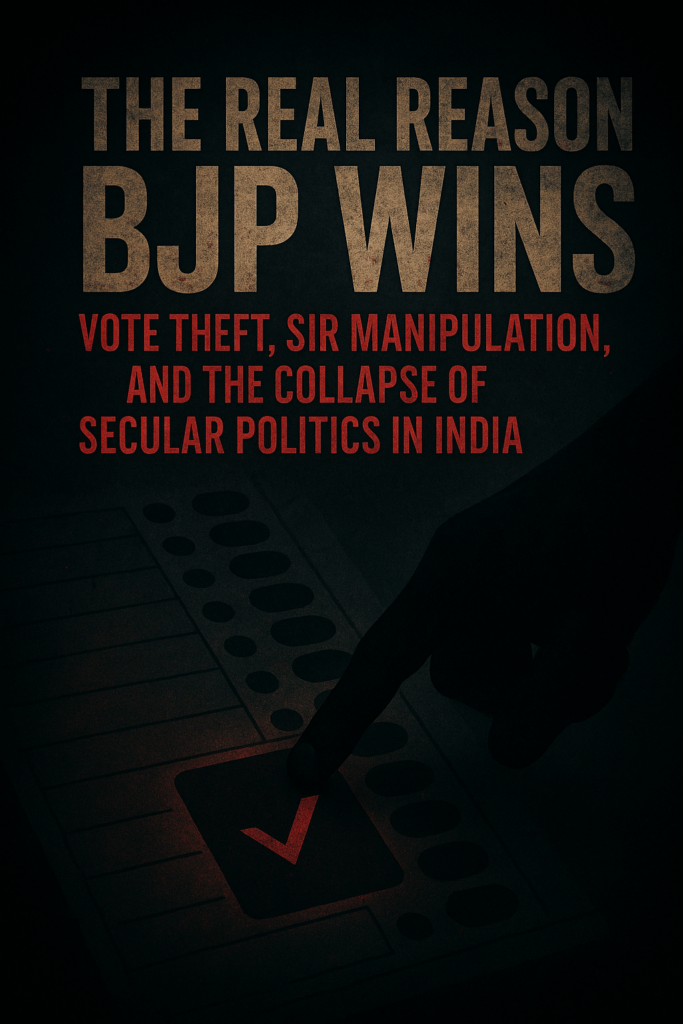
Months later, Rahul Gandhi raised the issue of vote theft. His team worked extremely hard and presented evidence and arguments that exposed the manipulation during the elections, clearly showing that the BJP’s victory in these states did not come from any welfare scheme, but from vote theft, fake votes, and duplicate votes.
Now it was Bihar’s turn. Rahul Gandhi had already exposed a major scandal that had influenced elections. In the 2020 Bihar elections, the two major parties were separated by just 12,800 votes. Around 42 seats had a margin of barely 1,200 votes. And suddenly, right before the elections, the Election Commission ordered an SIR (Special Intensive Revision).
Sixty-five lakh (6.5 million) votes were removed, and twenty-one lakh (2.1 million) votes were added. In a state where the previous election was decided by a margin of just 12,800 votes, here was a staggering tampering of 86 lakh (8.6 million) votes.
When 65 lakh votes were deleted, secular parties made a huge uproar. Social activists took the matter to the Supreme Court. The court dismissed the petitions by suggesting Aadhaar be accepted as valid proof. But the final voter list issued for the Bihar election was based on the new SIR — containing 65 lakh deleted votes and 21 lakh newly added ones.
What should have happened is that all secular parties should have rejected the SIR, announced a boycott of it, or even boycotted the Bihar election altogether — because the entire election was being conducted on the basis of an SIR-altered voter list.
Had they done this, the public — already aware of Rahul Gandhi’s revelations about vote theft and the shocking deletion of 65 lakh votes — would have risen strongly against the BJP.
But the secular parties did nothing of this sort. Despite exposing a scandal as serious as vote theft and raising a hue and cry over the SIR, they still jumped into the very election that was being played on BJP’s own chessboard. And not only that — they made the blunder of confidently claiming victory.
The results came out exactly as expected — because everything had already been calculated. The SIR had been done. After the results, the secular parties began crying foul again, even though they knew the impact of the SIR beforehand. By contesting the election and making big victory claims, they themselves weakened the issue of vote theft and the 65 lakh deleted votes.
Instead of shouting about vote theft, fake votes, duplicate votes, and the SIR, they should have taken to the streets in protest. A people’s movement should have been launched. But nothing happened.
When a journalist asked Rahul Gandhi at a seminar — where he presented evidence of vote theft — what steps he planned to take next, he simply replied that this was not his job and that other institutions of the country (perhaps referring to the judiciary) should look into it.
But what is the meaning of putting in so much effort, gathering such strong proof, and then abandoning the issue without taking it to its logical conclusion?
Twelve states, including Bihar, are now undergoing SIR, and elections are due in all of them within the next year or two. At the very least, after seeing the Bihar results, there should be serious work on countering SIR.
Mamata Banerjee’s party has opened SIR help centres across West Bengal.
A total of 6,200 centres are active in 2,861 municipal wards and 3,345 gram panchayats. These centres have been functioning since November 5, fully equipped with computers, laptops, printers, and Wi-Fi, and operate daily from 9 AM to 6 PM. West Bengal is heading for elections next year, and Mamata Banerjee is doing everything possible to ensure every voter’s name is included and to nullify the SIR’s impact — thereby blocking the BJP’s strategy.
Akhilesh Yadav was busy campaigning in Bihar, but is he now doing anything similar to what Mamata Banerjee is doing? After all, Uttar Pradesh will also go to elections in 2027.
The same question applies to Congress and other secular parties — are they as vigilant and proactive as Mamata Banerjee regarding SIR?
If not, then a few months after the elections, Rahul Gandhi will again hold a press conference explaining how votes were stolen — but it will make no difference.
That was about the secular parties’ failure on SIR. Now let’s look at their incompetence — and the BJP’s hard-work.
Vinod Tawde, a senior BJP leader from Maharashtra, said:
“The week Lalu Yadav and Nitish Kumar joined hands, Amit Shah told me: Vinod, you must go to Bihar. We have to win Bihar.”
Lalu and Nitish likely came together in 2022, meaning the BJP began preparing to win Bihar three years in advance.
When the election entered its final stage in October — when the entire BJP machinery was in Bihar, when multiple BJP chief ministers, top leaders, even the Home Minister and the Prime Minister himself were campaigning there — that is when Rahul Gandhi felt it was the perfect time to go on a trip to South America.
In the crucial final days of the election, he abandoned his campaign and flew to South America.
The BJP’s top leadership was actively involved in the Bihar election campaign. Amit Shah, Yogi Adityanath, Nitin Gadkari, Himanta Biswa Sarma, Rajnath Singh, JP Nadda — all of them kept travelling to Bihar for rallies and campaign speeches. Even Delhi’s Chief Minister Rekha Gupta was invited. Maharashtra’s Chief Minister Devendra Fadnavis also addressed rallies there.
But what was happening in Congress?
A talented leader like Shashi Tharoor himself said on national media that he was not even invited to campaign in the Bihar elections. After the elections, Congress issued show-cause notices to 43 of its leaders because many of them either did not work for the party or were found working against it during the most crucial days of the campaign.
Congress chose to use poet Imran Pratapgarhi in the election, while a more capable leader like Imran Masood was not brought to Bihar. Ideally, Congress should have invited all the Chief Ministers from INDIA alliance states to campaign in Bihar — but that never happened.
As for Lalu Yadav’s party, the RJD didn’t have a single strong Muslim face who could have proven effective in the Seemanchal region. Even if Asaduddin Owaisi’s party had not contested there, most seats in Seemanchal would have gone to the NDA due to Nitish Kumar’s influence.
A major crisis for secular parties today is that they have never allowed any Muslim leader to grow big in their parties. They sidelined even the few prominent Muslim faces they had. This vacuum is exactly why Owaisi is rising — he is filling the gap of Muslim representation. His entire narrative in the Bihar election revolved around this: Muslim leadership and their rightful share are being deliberately pushed aside.
Apart from this, on 11 seats, candidates of the secular Mahagathbandhan were competing against each other. On all these 11 seats, the BJP-led alliance won.
The seat-sharing among secular allies was never finalised properly. On the last date of nominations, more than half the candidates’ confirmations were still pending, leaving them with significantly less campaign time compared to NDA’s candidates.
The NDA parties performed exceptionally well, while not a single party of the secular alliance performed strongly. This has always been the problem — these parties have never been loyal to each other. Where RJD was contesting, Congress votes would drift toward NDA, and where Congress was contesting, RJD votes would shift toward NDA. This has happened repeatedly.
The secular alliance committed many such strategic blunders.
Those who try to blame Asaduddin Owaisi for the defeat are entirely mistaken.
Before the elections, Owaisi had tried hard to be included in the Mahagathbandhan and had asked for just six seats — out of which five were seats his party had already won previously. But while weaker parties were given dozens of seats, Owaisi was denied even six.
Tejashwi Yadav perhaps assumed that taking Owaisi along would push Hindu votes away — yet Hindu votes slipped even without him.
In fact, giving Owaisi just six seats would have helped the Mahagathbandhan run a focused campaign on the remaining seats. His presence would have resolved the leadership vacuum among Muslim voters, and the 22% Muslim votes that went to NDA because of Nitish Kumar could easily have been diverted to the secular alliance by Owaisi. This is exactly what he has been doing in Telangana.
Even though he contests only 7–8 seats there, the ruling party always keeps AIMIM close because Owaisi helps consolidate Muslim votes for them across Telangana. KCR and KTR understood this well. Later, the new Congress Chief Minister Revanth Reddy also understood it and aligned with Owaisi — and the results were visible on the Jubilee Hills seat.
But outside Telangana, secular parties intentionally label Owaisi as the BJP’s “B-Team”, harming themselves in the process.
After every election, some people blame Owaisi — and after the Bihar elections, they did the same. Some claimed that because of him, 20 seats went to NDA.
But if you actually examine the data, only 3 seats can be said to have been affected by Owaisi’s presence. At the same time, even Owaisi’s party lost out on 2 seats because of secular parties. On one seat, the AIMIM candidate lost by just 389 votes, and on another, he finished second with an 8,000-vote gap.
Some people oppose Owaisi not just politically but out of personal jealousy. Such people don’t even look at data anymore. They foolishly claim that Owaisi’s speeches turn entire elections into a Hindu–Muslim issue. How can one explain anything to people who ignore all factors and simply hold Owaisi by the collar? If this isn’t foolishness, what is?
Owaisi’s speeches today are far more measured than before. He even includes Hindus respectfully in many of his statements. In the Bihar election, he gave tickets to 2 Hindu candidates out of 25. None of his speeches reflect hatred towards Hindus.
He openly speaks for the rights and representation of Muslims — that is his core issue.
But after the Pahalgam terror attack and his strong stand on it, the label of “Muslim hardliner” that was forced on him has completely faded. Compared to before, his acceptability among Hindus has increased.
As far as the statement about making a Muslim the Deputy Chief Minister or Chief Minister is concerned — if every caste, community, and religious group in India has the right to demand leadership for their own people, then Muslims must also do the same. Whether they ultimately succeed or not is a different matter, but for a strong democracy, it is essential that Muslims speak openly and confidently about equality, just like every other community. Muslims must rise above inferiority complexes and the feeling of being deprived.
Apart from Asaduddin Owaisi’s party, the BSP also fielded candidates on 130 seats in the Bihar election and won only one. The Aam Aadmi Party contested on 99 seats but did not win even a single one. Yet no one called these parties “vote-splitters”. Their own communities — Dalits and Banias — certainly didn’t.
But Muslims, in large numbers, can be seen attacking Owaisi, calling him a vote-cutter and accusing him after every election of helping the BJP win.
The intensity with which Indian Muslims want to make secular parties win is far greater than the intensity these secular parties themselves show to win.
Instead of blaming Owaisi, Muslims should reflect on why 22% of them voted for the BJP-alliance in Bihar.
Prashant Kishor also launched his own party and contested elections for the first time. This is the same Prashant Kishor who helped Narendra Modi become Prime Minister for the first time. He worked for Nitish Kumar, helped Mamata Banerjee retain West Bengal in the most difficult phase, secured a sweeping victory for Kejriwal during the Modi wave, and helped Amarinder Singh in Punjab, Uddhav Thackeray in Maharashtra, and Jagan Mohan Reddy in Andhra Pradesh reach the Chief Minister’s seat.
Yet when he himself contested the entire 243 seats of Bihar — when he rose above Bihar’s traditional politics of caste, clan, community, and religion, and when he fought on issues like employment, education, development, women’s safety, and infrastructure — despite three years of hard work, thousands of kilometres of padyatras, travelling village to village, spending hundreds of crores, giving hundreds of interviews — not a single candidate of his party won. And this was despite the fact that his politics was clean and transparent.
Should Prashant Kishor also be called a “vote-splitter”?
Not just him — no political party can be labeled a vote-cutter. Political parties exist so that they can contest elections. Period.
Secular parties must take responsibility for their own defeat. They must introspect and identify where they are going wrong, where they fall short compared to the BJP. Before treating any illness, diagnosing it is necessary.
They must look within, and like the BJP, work hard on every front.